Monday, June 18, 2018

Turner Brashear


Turner Brashear is a 6th great uncle.  He was a brother to my 5th great grandfather, Tobias Brashear, who also settled in the Mississippi Territory.  This is my descent from Tobias...


Turner's story is interesting and integral to the development of Mississippi as a State.  He was witness to many of the foundational moments.

Shortly after control of the Mississippi Territory was loosed from the hands of the Spanish, the American gov’t sought to encourage overland travel, communication and commerce between the southern extremity of the territory (the Natchez district) and the burgeoning east coast. At the time, that meant making improvements to the Columbian Road or the “Natchez Trace” as it is known today.  This path linked Natchez with the growing settlement of Nashville in Tennessee.

The government sought to encourage proprietors to open Stands or Inns every so often along the route to make passage through the wilderness between Natchez and Nashville more hospitable and less dangerous. An Indian Agent and later Representative from Alabama, John McKee, noted in a diary entry of August 1, 1804-- “Mr. [Silas] Dinsmoor & Mr. Mitchell went out towards Natchez in order to look out for 3 or 4 places on the road suitable for stands or public houses.”

As the road meandered through the Choctaw Nation, use of any site chosen for the Stands required an agreement with the Choctaw. An 1805 treaty with the Choctaw allowed for the use of the property that was to become Brashear’s Stand. The following year a public house was advertised in the Natchez newspapers. One of Turner Brashear’s advertisements read, “The subscriber has opened a House of Entertainment and a Blacksmith Shop, on the Columbian road, 120 miles from Natchez, where travellers may rely on finding accommodations and supplies.” Turner was banking on the fact that a traveler four or five days out of Natchez would welcome the protection of a dry clean room in lieu of another night in the forest under an oilcloth.

By that time, Turner Brashear had been in the Mississippi Territory for nearly 25 years but he was a son of Maryland. Of French Huguenot descent, Turner was born a 5th generation American colonist. He and his 9 brothers and sisters were baptized at St. Barnabas Episcopal Church in Prince George’s County, Maryland. The 243 year old church building and even older baptismal font in which they were baptized are still there today. 

In 1773 Turner’s father moved the whole family to the outskirts of civilization on the Monongahela River. A few years later they followed the troops of General George Rogers Clark down the Ohio River to Bullitt County Kentucky and then on to the settlements of Cahokia and Kaskaskia in the Illinois territory during the Northwest campaign of the Revolutionary War. Two of Turner’s older brothers served under Clark in that campaign. By 1785, the family moved down the Mississippi and settled in the Natchez District. 

One family member stayed in Bullitt County. Turner’s oldest brother, Marsham Brashear, and a cousin, William Brashear, opened a Stand on the Old Wilderness Road near the falls of the Ohio River. This Stand was not unlike the one Turner would open a few years later. In a gruesome testament to the persistent danger found in the wilderness of the territories, William’s body would be found scalped and mutilated not far from their Stand. Marsham stayed on and operated the Stand for many years.

Turner was a long time acquaintance of John McKee. Both had been agents for the Panton and Leslie Company of Pensacola in their younger years. Trading with native americans all over the wilderness of what is Mississippi, Alabama and Florida today, McKee and Brashear made contacts and developed relationships with many tribes. Eventually, Turner settled among the Choctaw. About 1787 a 23 year old Turner married Jane Hotitoka Apuckshunnubbee, daughter of the Choctaw Chief Apuckshunnubbee. Their union produced 5 children and provided Turner an influential place in Choctaw politics. 
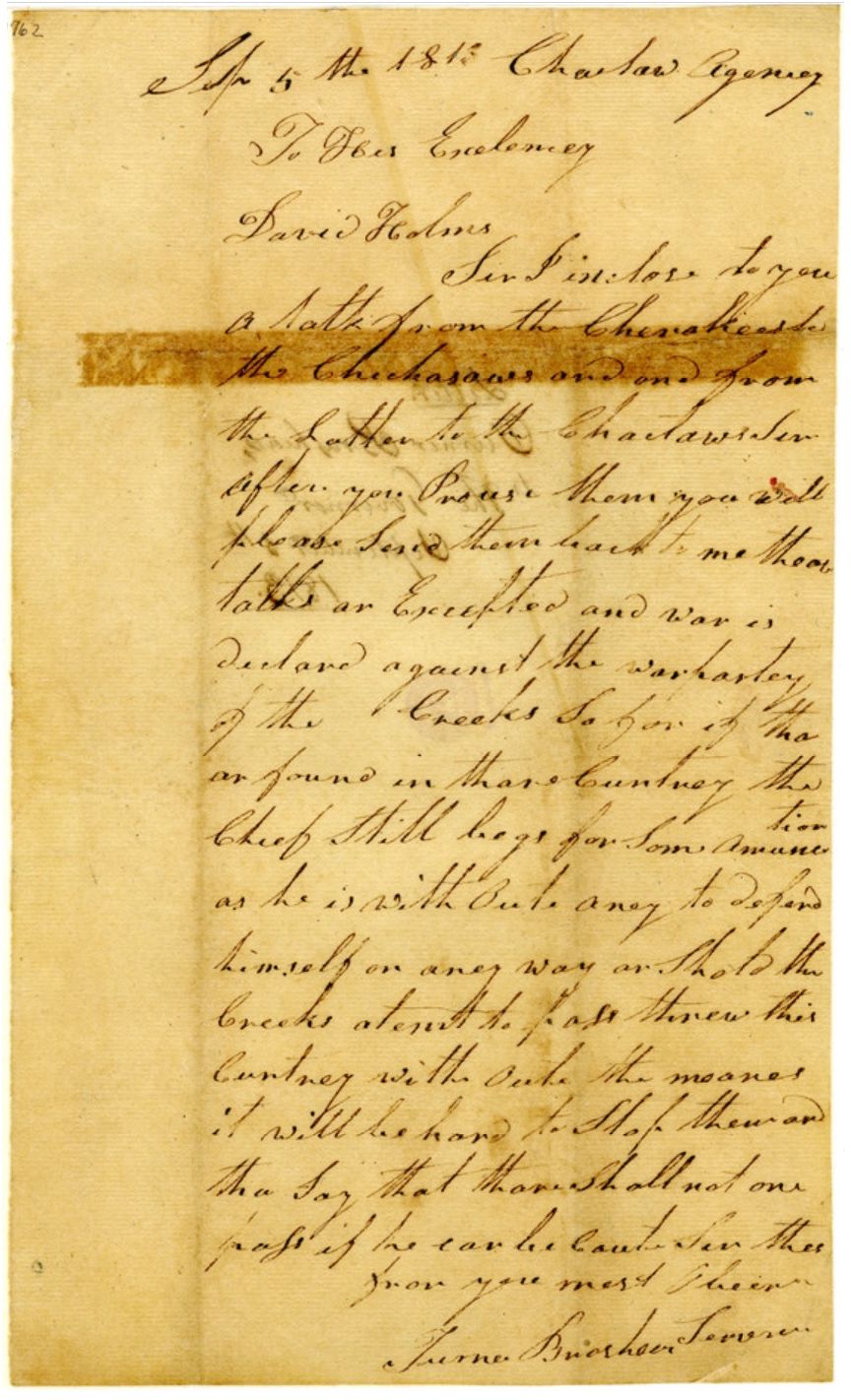

This is a letter dated Sep 5 1813 from Turner Brashears, Choctaw Agency, to Governor Holmes asking that he provide the Cherokees, Chickasaws and Choctaws with ammunition as they have declared war on the encroaching war parties of the Creeks.

His unique position made him sought after by the powers at hand. He served in the employ of the Spanish Government as interpreter during negotiations with the Choctaw. In 1792 the Spanish Governor, Carondelet, wrote of Turner, 
“Of all the white traders in this Nation [Choctaw], the one I met most ardent to our interests is Mr. Turner Brashears with whom I have consulted from time to time on matters relative to my mission, and I have always found him a man of truth and influence in this Nation; he is also an intimate friend of Franchimastabe and in whom he places his greatest confidence, the reason why he sent him [Turner] to Natchez to confer with the Governor." 
In 1799 the Americans also recognised his standing. Turner’s friend John McKee wrote a letter to U.S. Secretary of War James McHenry,
"...There ought to be an assistant agent- and an interpreter appointed in addition to John Pitchlyn. I would beg leave to recommend Turner Brashears providing he would accept as the additional interpreter- he is well qualified for the duties of Linguister, is a sober young man- has for some years past been an agent for Panton & Leslie Co. and has much influence with the Choctaws- his family lives in the Natchez district and is respected."
Turner did serve the American government as Choctaw interpreter for a number of years. He was paid an annual salary of $400. Turner’s signature is found on several important documents from the era including the 1816 Choctaw Treaty of Fort Stephens. 

His establishment on the Natchez Trace that became known widely as Brashears’ Stand played an important role in the early history of the area. While the original structure is long gone, it’s general location is now highlighted by the Natchez Trace Parkway as an historic site at milepost 104.5 at Ridgeland, Mississippi.

1807 Newspaper Ad out of Natchez


The Stand included a large farm, Blacksmith shop and open fields where race horses were likely housed during transit between race events held on both ends of the road and points beyond. As horse racing was very popular among gentlemen of the early 1800’s it can be expected that handlers would require board and provision for prize animals making the circuit at Brashear’s Stand.

With threats of an English invasion on the Gulf in 1813, Turner played host to the increased military traffic along the road outside his front door. We know that John Coffee stayed at Brashear’s Stand long enough to convene a courts martial there in 1814. After the Battle of New Orleans in 1815, Andrew Jackson’s returning troops used the Stand as a hospital. Brashear rented his rooms to six doctors (one to a room) who attended 300 or so of the sick and wounded encamped about the Stand. 

Turner and at least one son served in the Choctaw Regiment during the War of 1812. Turner held the rank of Major under Colonel John McKee in Andrew Jackson’s command.

General Index card for Turner Brashear


Turner is also frequently found among the records of the Choctaw Agency which was located about 4 miles west of Brashear’s Stand. He served as interim Agent between Silas Dinsmoor’s departure in 1816 and when John McKee resumed the role. A letter Turner wrote John McKee was found among the papers of William Clark, Governor of the Missouri Territory. Turner warned McKee about some effort to reinstate Dinsmoor as Agent. Turner refers to Dinsmoor or those who were seeking to reinstate him as a “snake in the grass” hinting at some strained relationships.

Turner Brashear, operated his Stand from 1805 until some time in the early 1820’s. His wife of 35 years passed away in 1822. A year later, Turner married another Choctaw that some believe was the sister of his first wife. She was Ocayemitta and they produced another three children. No evidence is found of him after the Census of 1830. It is assumed he passed away about 1831 near his daughter in Yazoo County, Mississippi. Some of his half-blood children remained in Mississippi while others made the trek west to Oklahoma. His descendants are scattered around the country.

National Park Service sign as it used to appear at Brashears Stand

Wednesday, June 6, 2018

Climbing the Keller family branches

James Jefferson R Keller

For the longest time, the shortest branch on my family tree was my mother's line-- the Keller family. Four generations back was as far as I could go. The line slammed to a halt on a river bank at a Civil War army encampment. The family story is that great great grandmother, Harriet Jane Ramsey Keller, received a letter from her husband, 26 year old James Jefferson R Keller stating that he was ill and encamped with the army beside a river. The family never heard from him again. Harriet was home with their two boys, William Thomas who was 6 at the time and James Jefferson (Jr) who was a year old. This letter is out there somewhere. I have found it described by two or three family members, but I’ve had no luck finding a copy of the actual letter.

Luckily, we do have service records for James Jefferson R Keller. They show he was mustered in the 10th Alabama Infantry Regiment on March 1st, 1862 at Gadsden, Alabama as a Private. The muster roll also tells us that James was a married 25 year old at the time of enlistment. Farming was listed as his occupation and his residence was marked as Duck Springs, Alabama which is about 10 miles north of Gadsden.

Of the 8 or 9 engagements listed on his unit’s muster rolls, James is only counted present at the Siege of Yorktown (Virginia) fought during April of 1862. The battle was generally inconclusive with the Confederates withdrawing to Williamsburg. I found a requisition form dated April 9, 1862 signed by a Sgt. James Keller of the 10th Alabama at Camp Winder. James had been promoted in the month or so he had been in the army. Camp Winder was at Richmond and served as a hospital consisting of 98 buildings and 125 acres of farmland. The next battle his unit participated in was the Battle of Williamsburg on May 5, 1862. James is not marked present. Presumably he was ill by that time and had been removed to an encampment to recover-- maybe back at Camp Winder. The family gets his letter but he is never heard from again. There are no records for James after April of 1862.


James M Keller

There was another James Keller in the 10th Alabama Infantry Regiment. Pvt. James M Keller served in the 10th Alabama from June to October 20, 1861 when he was medically discharged due to rheumatism that hampered his ability to perform the duties required of a soldier. James M Keller was 46 years old when he enlisted at Jacksonville, Alabama. I found the location significant. Jacksonville is 35 miles south southeast of James Jefferson R Keller’s 1861 residence at Duck Springs. James M was 20 years older than James Jefferson. The geography, the last name, the fact that they served in the same unit (albeit not concurrently) leads one to believe they were likely related. In fact, I see in cousin Ella Merle Emery’s files that she knew of James M Keller and even suggested they could be father/ son.

I have since found that James M did have a son named James, but he was James Austil Keller born 13 years after James Jefferson R Keller. I find it unlikely that James M would name two sons James. What seems more likely is that James M could be an uncle or cousin of James Jefferson.


Keller yDNA

This theory got a boost when we were able to test a Keller family member’s yDNA. In 2015 I contacted Ella Emery (mentioned earlier) about finding a Keller male who might test for us. My grandfather, Bill Keller had all girls, so I knew I would have to reach out to a cousin for this task. Ella was my mother’s first cousin on the Keller side and an established genealogy juggernaut. Ella suggested I contact Hugh Keller of Lonoke, Arkansas. He descends from one of my grandfather’s older brothers and he has an interest in genealogy and, in fact, had already done an autosomal DNA test. Hugh was graciously receptive and a few weeks later we had a Keller yDNA kit at the FTDNA website.


A couple yDNA cousins check in

In January of 2016 an email from FTDNA alerted me to a close yDNA match that had shown up for Hugh Keller. It was a Mike Keller from Oklahoma born in 1951. His sister Loretta administered the kit. I emailed Loretta and quickly found that Mike and Loretta descended from James M Keller of the 10th Alabama. Our suspicions were correct. James M is one of our Kellers. The circumstances of the match and the timeframe/ geography of the lives of the two men strongly suggested to me that James M was most likely an Uncle to James Jefferson. James M’s father would be James Jefferson’s grandfather.

Unfortunately, Loretta didn’t know much about James M’s father. James M Keller was their brick wall. He had survived the war and eventually passed away in 1898-- he lived long enough to be recorded in the 1880 census. It’s there we find an interesting tidbit, James M claimed his father was born in “England.” Another clue provided by Loretta is what her family had passed down via oral tradition. From Loretta...
...there is some family lore that I found interesting. I believe this would relate to the father of James M. Keller. My oldest aunt (born 1890’s) indicated she was told that their ancestor was shanghaied by the crew of a ship bound for America. When they reached the Virginia shore he jumped off and swam ashore.
Oddly enough in some Keller forum I visited years ago, someone doing research on the James M. Keller lineage said that according to their family lore their ancestor was shanghaied from Ireland by a ship bound for America. When they reached Virginia, the boy jumped ship and swam to shore and hid in the Keller family tobacco fields. He was found by servants of the family and brought to the house. The Keller family took him in and gave him their name. According to her the family that took him in is the line that Helen Keller derives from. As she also pointed out, if family lore proves true, we may not actually be “Kellers” at all.
Fascinating! We know that James M is of the Kellers that we descend thanks to yDNA testing and we know that our lineage came from England the generation before James M. As far as I know, my branch of the Keller line had passed no such story down. We knew nothing about any ancestor beyond James Jefferson R Keller who died in the Civil War but now we know that it is very likely, James Jefferson’s grandfather came from Britain. The “shanghaied” story is interesting but I’m always hearing how family lore is notoriously unreliable.

The month after corresponding with Loretta, I received the following email from another distant Keller cousin-- William Keller of Birmingham, Alabama…

I recently checked my DNA results and found that Hugh Keller and I may be related, because of ties to where they lived. My Keller great great grandfather moved from northwest Georgia to the Conway, Ark., area in the 1850s, before he and his family moved back east to north Alabama in 1860, southeast of Decatur, Ala. That ancestor was Alfred Burton Keller (1829-1910), and we think he had traveled to Arkansas with other members of his family and his wife’s family, the Tilleys. We also think his father was an immigrant from England, probably Thomas Keller, who shows up in Habersham County, Ga., in the early 1800s...
After some checking, I found that William Keller (actually the test belonged to his brother Thomas) did show up on Hugh Keller’s yDNA matches but Thomas’ test only included 12 markers. I had been focused on matches that tested 37 or more as they are more predictive of recent common ancestors. Thomas’ match at 12 markers is a good match, but only concludes there is a common paternal ancestor within the last great many umpteen generations. Based on 12 markers our common ancestor could be a 24th great grandfather-- so far back that it’s not particularly helpful. But, it very well could be a more recent ancestor. Our geography of our recent families and the few number of generations since immigration would lead me to conclude the connection is more recent. There is just no way of knowing for sure except by testing more markers.

What I did find eye-opening in William’s email (and I think what he was driving at) is the reference to Georgia and Conway, Arkansas. James Jefferson R Keller’s wife, Harriet Jane and her two sons made this same trip from Georgia to Conway, Arkansas 20 years after William’s ancestor’s family returned to north Georgia. Harriet moved and settled in 1881. One of her son’s returned to North Georgia not unlike Alfred’s family had done. This seems more than coincidental. Some of Alfred Burton Keller’s family did stay in Arkansas and would have been in the area when Harriet arrived- specifically some of his wife’s Tilley family.

William’s Alfred Burton Keller was born in 1828 and died in 1910. He claimed to have been born in Georgia like James M Keller. Interestingly, William’s email mentioned England. After researching Alfred Burton Keller, I found that he recorded twice on federal census forms (1880 and 1900) that his father was born in England. William further conjectured that a Thomas Keller of Habersham County Georgia might be Alfred’s father.

I began to theorize that James M. Keller and Alfred Burton Keller were brothers. They were born about 13 years apart in Georgia to a father born in England. Their descendants match yDNA. This would likely make them both uncles to my James Jefferson R Keller who was born in Georgia 20 years later.

There was another zinger from William’s email. The last paragraph contained this...
...Family legend has it that two Keller brothers jumped ship somewhere on the east coast
My two new cousins, William Keller of Birmingham and Loretta Keller of Oklahoma had no knowledge of each other. They had never communicated. Their families had not been in contact in all likelihood for at least 120 years yet they share a similar family lore. While it doesn’t prove anything, it sure is interesting.


James Jefferson R Keller’s father

In 1850, James Jefferson R Keller (15 years old) was living with his mother, his maternal grandmother, three brothers and one sister in Franklin County, Georgia. A father for that family was not enumerated in the 1850 census. James’ mother, Mary Ann (Oliver) Keller, was listed as head of household. The youngest brother was born in 1842, so we can assume Mary Ann’s husband (and James’ father) passed away between 1842 and 1850. The 1840 census should reveal a Keller family with 3 boys and one girl, a 32 year old mother and a 30-something father. Unfortunately, the 1840 census only names the head of household. Other members of the household are simply counted and sorted into an age range. It does not name them. So we can’t search for Mary Ann Keller as she was not the head of household.


Bordering Franklin County to the northwest is Habersham County, Georgia founded in 1818. Mary Ann’s mother, the widow Elizabeth Oliver, is found there in the 1840 census in Long’s district with her own household. Two rows down on the same census page we find Wm. M Keller with a family whose ages align with what we would expect of James Jefferson’s family in 1840 with the addition of one female aged 10-14. She would likely be an older sister of James Jefferson or a cousin helping out with chores. I think it is Polly Ann Keller who married Daniel Kester in Franklin county in 1841. Not sure that she is a sister, but seems plausible. On the same census page, five lines below Wm. M. Keller we find "Brazel Addison’s" family counted. James Jefferson’s sister, Rachel Keller, married a son of this Braziller Addison in 1852 just over in Franklin County. These connections are circumstantial but are convincing enough for me to believe William M Keller was Mary Ann’s husband and James’ father.


I’ve only found a couple other documents that may serve as evidence for William M Keller. They are tax role indices. Probate records or land records would be ideal. There is a property tax document from Franklin County (1832) with a William Keller listed. He is listed with Christopher Addison acting as agent. I’m not sure why William needed an agent. Maybe because William was living in the next county and needed someone to handle his affairs in Franklin County? Interestingly, this Christopher Addison’s niece (by marriage) became the spouse of our James Jefferson R Keller. If William M Keller is not James Jefferson R Keller’s father, he sure is running in the right circles.


James Jefferson R Keller’s grandfather

Given the assumption that William M Keller was James Jefferson's father, it follows that Alfred Burton Keller and James M Keller (the two lines put forward by yDNA evidence) were brothers of William M Keller.  It's also possible they were cousins, but both Alfred B and James M's families indicated their father was from England on subsequent census records.

Several of Alfred's descendants found at Ancestry.com indicate that Thomas Keller of Habersham County, Georgia is the father of Alfred.  Thomas is found in one census record, the 1830 census of Habersham County, Georgia.  Some of his neighbors in that 1830 census include the familiar Addison, and Chaffin families.  Coincidentally, I also found our Allen family and Cleveland families listed as neighbors of Thomas Keller although they don't tie in to the Keller line for several generations.

There are a number of factors that point to Thomas Keller being the probable father of our William M Keller other than his familiar 1830 neighbors.  Thomas Keller is widely acknowledged as being of English birth, though I haven't found specific proof.  He passes the "in the right place at the right time at the right age with the right name" test as well.  I think it's also telling that though admittedly common, the names "Thomas," "William," "James," and "George" occur with great frequency in all three families for generations.  Because of the foregoing circumstantial evidence, and the fact that our close yDNA cousins have earmarked him, I currently show Thomas Keller as William M Keller's father in my tree...


Naturally, this is a work in progress and subject to change.  You will notice some other Kellers in that tree.  Delilah and Mahalia Keller were sisters of Alfred B Keller.  All three of them married into the Tilley family.  This is the family that DNA cousin, William Keller of Birmingham, said went to Conway in the 1850's then most returned to Georgia.

Barnett A "Barney" Keller

On the left of the above image is the curious addition of Barnett A "Barney" Keller.  I added him to my tree because I have found autosomal DNA cousins that descend from him in my list of matches.  When I look at the common or "shared" matches of these "Barney Keller" DNA cousins I find, overwhelmingly, known Keller family cousins, so I'm sure Barnett Keller ties in to our Keller family somewhere.  I have not found a descendent of Barney who has tested yDNA.  That would help immensely.  

Like our James Jefferson R Keller, Barney died during the civil war.  In 1853, when our James Jefferson R Keller was 18 years old, Barney Keller named a son "James Jefferson Keller."  Maybe that name was more common than I figure, but it caught my eye.  Barney's son was born in Alexander County, North Carolina.  Barney, we believe, was born in Burke County, North Carolina.  Though most of what we know about our James Jefferson R Keller's family is out of Habersham and Franklin County, Georgia, his mother, Mary Ann Oliver, was born in North Carolina, so there is some connection with the State.

Much more research is required.  The lack of probate and marriage records pertaining to the early Keller families of North Carolina and Georgia is highly frustrating.  Hopefully more helpful documents will become available with time and we can nail down some of these relationships.  This is where it stands today.  I'll be updating as more evidence surfaces.

Wednesday, May 16, 2018

A.F. Kuykendall by Ivah Kuykendall


My Father – A.F. Kuykendall
-by Ivah Kuykendall-

Papa at the Pool

I wish everyone could have had a father like mine.  He was the idol of my life.  He was so large and strong looking, and was always dressed appropriately-- even when he worked all day, with farmers who lived on the Frauenthal farms & there were many of them in Faulkner, White, Cleburne and Conway counties.  He would see that they had the necessary things they needed for their year’s work & that they could borrow money from Frauenthal and Schwartz to tide them over.  He could tell at the end of the season how many bales of cotton or bushels of corn etc and then see that they paid their debts to F&S at the end of the year.  Sometimes they were tempted to take their cotton out of county to have baled & then neglect paying F&S but Papa had a method he worked out by counting tolls on stalks. Then the stalks on a row and the rows and he could tell, to the bale, how much each farmer made.  All the customers knew he could estimate and therefore he never had any trouble with them on settlements.

Papa was a true Democrat.  He was the Democrat leader for Faulkner County.  Traveling as he did he learned lots & gave good advice.  He was many times persuaded to run for any office but never let them talk him into running.

All young people liked papa as well as the old people.  He could talk to any of them on any subject.  Papa didn’t see evil in anyone.  He listened but didn’t criticize.  Papa loved and respected his family.  Gave each child its share of attention and needless to say, how much his children loved and respected him.  Thanks to Mama!  She adored him and made us feel he was the finest & I knew he was the best looking!

Papa was the gentleman farmer, you might say.  He always held a job, at first a surveyor, then he worked at the Faulkner County Bank, and later for 25 years with the largest firm in the surrounding counties-- Frauenthal and Schwartz.  But he also knew everything going on around our farm.  He always had an overseer who lived on the place and Papa planned with him.  We grew cotton and corn.  Mama always had acres of vegetables of every kind.  In those days bugs & insects were not bad so no one ever had to spray.

When we were children papa played with us lots.  He always saw that we had horses to ride and I can remember when he brought us two little “jennies.”  We could ride them any time we wanted to.  They were really no good for anything else. We would have lots of friends from town who loved to come to our house because we were a big happy family with many interesting things to do.

In those days there were no entertainments- only what we made ourselves-- playing dominoes, checkers, hop scotch or marbles.  It wasn’t until we moved to town that we had a Victor Victrola.  Papa would let us buy records and he enjoyed listening.  We had many beautiful records.  Then came the day when we got our first radio!  The first one we got we had to use ear phones.  Then in a year or so we graduated to the kind where we could sit quietly in front of it and hear the wonderful news and mostly classical music.  That was great!  Every afternoon at 5pm “Amos &* Andy” came on and Papa would come in, turn it on and listen.  Then when it was over he flipped it off until the news came on at 6.

Papa dearly loved Roosevelt and when Roosevelt gave his fireside chats, papa would take a bath, dress himself up, get his cigar and go in and sit in front of the radio and listen to every word he had to say.  Never let us utter a word until it was over.  Then he always said, “that is the greatest man living.”  I believed him too.

As far back as I can ever remember Papa took the Gazette and each morning, summer and winter, he was on the porch to meet the Gazette boy.  I didn’t have to read the paper because he would read it to us while we ate breakfast.  Then in the P.M. he was ready to read the afternoon paper.  He called it the “Gimlet” or the Cabin.  The real name was “Log Cabin Democrat”.  We didn’t dare touch it until he finished reading.  How I would have loved to just get hold of that paper. 

Papa was loved and admired by his grandchildren.  He demanded respect & love from them.  They loved him and waited on him hand & foot.  I never saw my father take a drink or use an ugly word or curse.  His “by word” was “By Thunder”.  I often wondered what that meant.  Papa was a truthful, honest person. 

Every fall a circus would come to town “Barnham & Bailey” and Papa always took the whole family.  He thought it was educational for us to see the beautiful animals and acting etc.
I can never remember any time at Xmas that he didn’t see that we had a Xmas tree. It was lots of fun because our cousins and their parents came and they brought their gifts for their children.  I had one Aunt who had 2 boys and 2 girls.  She was Papa’s ½ sister.  Papa always had a gift on the tree for each one of them.

It was a great day when Conway got its first electricity.  We had our house in town strung for lights.  The wires were not in the attic.  We could see them.  They thought that was safer.  All the children, Papa & Mama got ready for the great event-- turning the lights on.  What a great day.  Then when Conway got water piped in we were the first on the line in Conway to get water.  The pipes came right thru our property for at least a mile.  Papa gave them the “right of way.”

When we lived on the farm & we were all small except the 2 older boys & Hettie, Papa bought us a surrey with fringe on it.  That was about 1906 or 7.  We children went to Church in the surrey and Papa and Mama took the 2 little boys and went in his buggy.  He always drove 2 farm horses to his buggy and that was a sight to behold.

The men and boys sat on one side of the house and the women and girls and babies on the other side.  I couldn’t enjoy Church for looking at Papa and wishing I could sit by him.  When Claudia and Ella got old enough to take Elizabeth and me with them we went to Church in town-- also Sunday School.  Papa said he’d rather go out in the country because he chewed tobacco and felt like it wasn’t proper to spit out the window in a town Church.

Papa was miserable when he retired.  In those days there was no retirement benefits, so he decided to build a swimming pool.  He had to have help in running it so Claudia and I stayed with him for 17 summers.  I taught in Conway & Claudia was Assistant to the Supt. In Ft. Smith so we had our summers free.  Many summers the brothers would help us, especially those depression days when they would be laid off their work.  They always knew they would be welcome back at home until they got other work, so therefore, they would help us.


Papa and Mama on their Golden Wedding anniversary


Papa always was at the pool.  His big responsibilities were supervising and advising.  He had his big rocking chair and he sat there and visited with people when they came.  Really that’s where he did his advising the people on politics.

When he got too old to stay down there all day, he sat under a big tree in front of our house and entertained himself counting the cars and people going to the pool and at the end of the day he could estimate how much we took in that day.  He never got too old to help get the days earning ready for the bank.  Hardly ever made a mistake counting those nickels and dimes.

Papa loved to burn grass.  He called it cleaning up & getting rid of weed seed & bugs, etc.  One day when he was become very old he wandered down to the pool (in the Fall) and thought he’d just burn around a little, so when he got ready to come home he thought he had the fire put out.  While we were eating supper one of the little King boys burst in the front door yelling “Uncle Frank, your swimming pool is burning down.”  Sure enough it wasn’t the pool but the building and all the contents.  Lucky to have it- the boys, Oscar leading and supervising it built another building and it was ready when the next season opened and it was a dream.  The whole upstairs was a big bedroom.  Claudia and I always slept down there and we always had several who shared our big room upstairs—always the lifeguards and the nieces and nephews when their grandmother and “Bad” (Hettie’s nickname) would let them.

Now back to Papa.  He had a very interesting as well as hard life.  His father died when he was 3 years old.  “Mother” (That was his mother, so all of us called her “Mother”) was left with 3 children.  Uncle Elias, Papa and Aunt Rebecca.  The Civil War came along and Papa was a very young child.  Uncle Elias was large enough to carry water to those who had to stand watch on duty.  Then when war was over Mother married her second young man, John P. King, who happened along.  He was a dashing young man!  Years younger than mother so she & he married.  They had 3 sons—Eslie, Balus, James (Jim) and one daughter Barbara.

When Papa became 17 years old he decided to get out on his own.  He had helped his Stepfather clear land and had done some farming. That was on the piece that later Papa bought, the place where his father and his mother owned—where we live now.

Papa left home and went to Texas and worked on a ranch for a year.  Then he came back to Arkansas and he and Mr. Livingston rented some land on the river.

Papa’s schooling-  Each child had for his primer a paddle hung around his neck with the alphabet on it.  Everything was memorized.

 As far back as 1856 there were no schools in Faulkner County.  Papa, born in 1856 described the school he went to as a he remembered.  His old grandfather Kuykendall, known as Granddaddy Kuykendall, [Adam Robert Kuykendall Jr] gathered all the children around him and taught them while their parents worked.  He had a fair education since he had been reared in North Carolina and Virginia.  This was a little settlement north of the present site of Conway.  Most of the children were relatives.  He got no salary.  Later my father went to a school 3 miles from his home. The teacher got a very low salary and the children’s parents took turns keeping the teacher.

Papa learned to survey by hiring a black man who knew how to survey.  Papa never told him he couldn’t survey so he became a very good pupil. 

A.F. Kuykendall Family, 1917:
Left to Right Top Row: Marcus, Oscar Stone, Claudia, Ella, Hettie, Ivah, Elizabeth
Seated: Mary Catherine “Mollie” Allen Kuykendall (Mama), Adam Franklin Kuykendall (Papa)
Bottom Row: Hiram, Robert and Arnold


Thursday, May 3, 2018

Aunt Pinkie's Memoir


Henrie Sentell Gladden


Henrie "Pinkie" Sentell Gladden was an older sister of my paternal grandmother, Annie Lou "Lucy" Sentell McBride. They were really half sisters, but you will read in Pinkie's memoir that they barely thought about that distinction.


In the summer of 2016 I made a pass through Baton Rouge and stopped at the LSU library. I knew they had a copy of Aunt Pinkie's hand written memoir. The staff let me take pictures of the pages with my phone. I didn't have my glasses so some of my photos turned out blurry, but I was able to transcribe the whole thing. It was about 62 handwritten pages. Here is what the first page looked like...


I made a PDF of my transcribed copy. It's much easier to read than the blurry photo'd pages. It's a great read. I can't promise I got every word right-- especially some of the names of people I don't know. Aunt Pinkie's handwriting was just fine; it was my photography that was lacking.
See the whole memoir at this LINK to PDF of Henrie Sentell Gladden's memoir.


Wednesday, April 11, 2018

When Cousins Marry

I was talking with someone about one of their 9x great grandparents.  The question came up-- how many ninth great grandparents do we have?  It turns out we typically have 2,048 ninth great grandparents.  Naturally, the number doubles with each succeeding generation.  It's simple math.  That is, until cousins get married.

There are several instances of cousins marrying each other in my tree.  One marriage, way back there, is in my direct line.  7th great grandmother Elizabeth Brashear married her first cousin Samuel Brashear in December of 1717 in Prince George's County, Maryland.  Even more egregious, they were double first cousins.  Their fathers were brothers and their mothers were sisters.  I understand cousins marrying was fairly common at the time--  well, maybe not double cousins.

The effect of this union changes the number of ancestors one can claim up and down the line.  Because they were double cousins, Elizabeth and Samuel shared both sets of grandparents.  Imagine sharing both sets of your grandparents with your spouse!  Their child, Benjamin has only 4 distinct great grandparents instead of the normal 8.  See in the graphic below how some of my 9th great grandparents show up twice in the same tree.  Each color represents an individual person.


The reduction in ancestors caused by this cousin union affects every descendant all the way down to me.  Instead of having 2,048 9th great grandparents, I have 4 less @ 2,044 (assuming there are no other cousin matches in my tree somewhere).  Consequently, that reduction doubles with each preceding generation.  I have 8 less 10th great grandparents and 16 less 11th great grandparents than typical.

Friday, April 6, 2018

Ursule Rose Dubois des Corbières

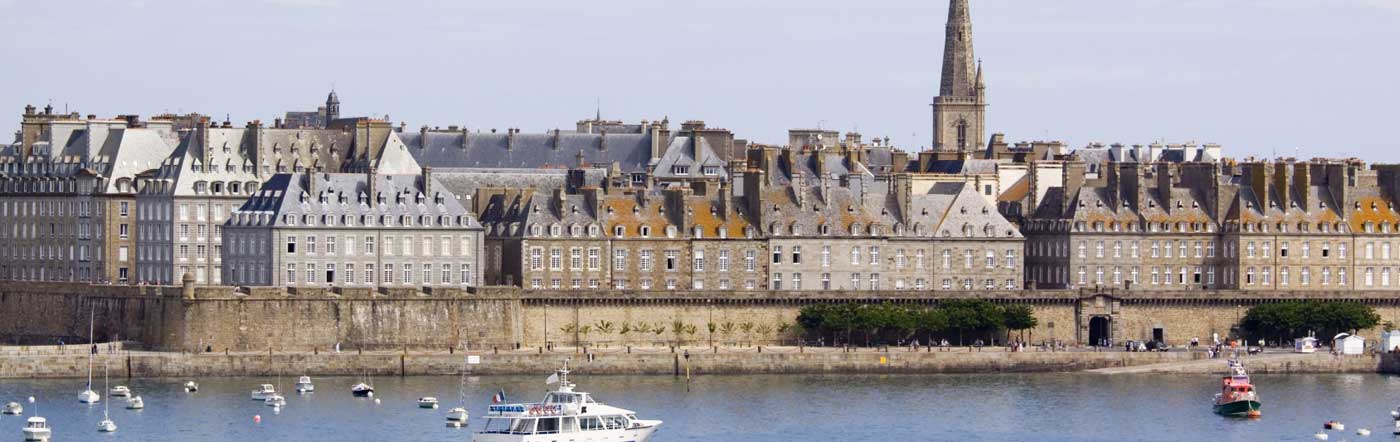
Saint-Servan-sur-Mer, Ille-et-Vilaine, Bretagne, France 


Virginia Lobdell Jennings in her book, "The Plains and the People," casually makes a claim that I have always found just a little bit brow-raising.  Her statement goes like this,

"Eugene Amedee Sherburne came from the vicinity of Rosedale, Louisiana and settled at Fontania Plantation near Port Hudson about 1835.  In later years this was called Fontania Landing.  His father or grandfather was in the diplomatic service in France and married Rose de Corbain who was wardrobe keeper for Marie Antoinette.  Eugene Amedee Sherburne joined Plains Presbyterian Church in 1857, died in 1859 and was buried on his plantation." (p.338).

Everything is great until you get the the phrase, "...who was wardrobe keeper for Marie Antoinette."  Though I can't claim to be fully aware of what that position entails, I would expect to see a footnote with sources cited for a claim like that.  Unfortunately, there is no indication of where that information originated.

Jennings book was published in 1998.  Many records have become more readily available since then.  We know now that Eugene Amadee Sherburne was born in France and it was his father, Samuel, who was indeed a diplomat.  Eugene's mother's name was actually Ursule Rose Dubois des Corbières.  I count her as a fourth great grandparent and she was 100% French, but was she wardrobe keeper for Marie Antoinette?

So lately, I've been researching- Who was Ursule Rose Dubois des Corbières and why is her name frequently followed by "des Corbières?"

There are two locations in France that go by the name "Corbières."  One is a district in the south of France near the Pyrenees famous for its red wine production. The other is a section of the town of Saint Servan in the vicinity of Saint Malo.  This is a well known resort area in Brittany- on the northern coast of France.  St Servan and St Malo bleed into each other today.  This Brittany location is where we find United States Consul Samuel Sherburne and his bride, Ursule Rose Dubois in the late 18th century.

The first breakthrough came from a marriage record found for Ursule Rose and Samuel.  This is a fortunate document because not only does it give us a date and location for the wedding, but it also names the parents of both the bride and groom.  The wedding happened on August 3, 1796 at Saint Servan-sur-Mer, Bretagne, France.  We also have a St. Servan baptismal record for Ursule Rose.  We can estimate an early 1768 date of birth based on the October 13, 1768 baptism date.  This baptismal record seems to refute the DAR applications I'd previously been relying on that indicate her birth in 1776, Nantes.

Both the baptismal record and the marriage record name Rose's parents as Claude Dubois and Elizabeth Charlotte leMortellec.  Claude, I have learned, was a very prominent merchant, ship owner, alderman and treasurer for the local Parish at St. Servan-sur-Mer.  We now have birth and marriage records for him as well.  He was born in Brittany in 1725 and after the death of his first wife, married Elizabeth in 1757.  It is said he had 4 children by his first wife and 10 by Elizabeth Charlotte leMortellec.  Our Rose is the youngest of all of Claude's children.

Claude bought a substantial property in St. Servan-sur-Mer on September 9, 1756.  This was in the area known as Les Corbières.  There, it was most likely he who built or substantially renovated a Pavilion house 42'x 37' with cellar, a raised ground floor, upper floor of sleeping rooms and finally a mansard floor with additional rooms.  It is believed the original structure dated to the 1720's.  The house still exists.  It was substantially renovated and increased in size in 1900, but pictures of the original structure from the 1870's,  or so, show what it looked like when Rose was born there...

Dubois home sometime before 1900.  This is the home Rose was born into.

The home after the 1900 additions


The city of St. Malo and the surrounding area was virtually demolished during the Allied invasion of France in 1944.  It is estimated that only about 20% of the existing structures were salvageable due to the bombardment.  After the war, for a period of about 30 years, the buildings were "lovingly recreated stone by stone" says the local tourist brochure.


The Dubois family lived in the Les Corbieres area of St Servan for many years.  The area has a rich history.  Settled in the 1st century BC, it has been occupied by many peoples.  The Celts settled the area.  The Romans fortified it. In the 6th century, Irish monks established a monastery.  The monks are credited with naming the island in honor of a celtic bishop named Maclow.  This name has come down to us as Saint Malo.  Interestingly, St. Malo is similar in appearance to and not very far from the more well known island commune, Mont Saint Michel.  

During the time of the Viking raids, the surrounding inhabitants of St. Malo moved to the island and fortified it further.  In the 1400's through the 1700's and even up to the time of our Claude and his daughter Rose, the port was home to the famous French Corsair raiders- Privateers for the King. 

St. Malo about 1860

From the beginning, the port at St. Malo had been a very important node for international trade.  This is no doubt the impetus for Samuel Sherburne's initial contact with the Dubois family and meeting his future wife, Ursule Rose.  

Samuel Sherburne was born in New Hampshire to a well-to-do and established family.  He secured the position of United States consul at Nantes.  I believe this might explain the supposition by the DAR applicants regarding Rose's birth location. Nantes is about 95 miles due south of St. Malo.  

A consul was responsible for facilitating trade between a host country and the U.S. and also protecting the welfare of U.S. citizens abroad.  In Samuel's day, this primarily involved providing assistance to indigent U.S. sailors within his area of influence at Nantes.  Samuel served under the presidencies of John Adams, Thomas Jefferson and James Madison from about 1792 until about 1816.  He was only 22 years old in 1792.  

James Monroe would be the following President, but in 1814, he was Secretary of State and oversaw the duties and actions of all U.S. consuls.  I found a letter from that year in which he dismissed David Warden, the consul at Paris, and requested information  on  the conduct of Samuel Sherburne, the consul at Nantes and Mr. Vail, the consul at L'Orient.  I haven't found a response, but would be very interested to read it!  I did discover, however, that Mr. Vail, mentioned in the letter, was not only a fellow U.S. consul in a neighboring city, but was also Samuel's brother-in-law.  Aaron Vail, merchant of New York, married another daughter of Claude Dubois.  She was Elizabeth Ursule Dubois and they married 5 years before Samuel and Rose.  Both weddings were in Saint Servan-sur-Mer.  

Aaron Vail was an interesting character.  He had an abiding interest in the prospect of steam powered ships and became acquainted with a man named John Fitch.  Fitch was an American engineer working on a design for steamboats.  Vail invited Fitch to France to develop his prototype.  Fitch accepted but struggled in the execution due to the ongoing French revolution.  Fitch returned to America leaving his plans and sketches with Vail.  Vail eventually turned over the documents to another acquaintance, Robert Fulton!

Vail passed away in late 1813 and his wife and 6 children subsequently moved to Washington DC.  About this same time, Samuel and Rose Sherburne and their children moved to Baton Rouge, Louisiana.  Claude Dubois had passed away by this time but you wonder if the family was marrying daughters off to Americans intentionally- maybe to escape what was going on in France at the time.  Between Elizabeth's wedding and Rose's wedding, the French Queen, Marie Antoinette, had lost her head.

But none of this confirms whether or not Rose was "wardrobe keeper" of the Queen.  I have yet to find evidence for this claim.  Rose was 25 when the Queen was executed.  So, I suppose the dates work out ok.  It's possible.  The geography doesn't make sense.  Paris is 200 miles from St. Servans.  Wouldn't the wardrobe keeper need to be in the same location as the queen?  Perhaps Rose lived in Paris for a while in her teens?  We will need evidence.


St. Malo today

We don't know a whole lot about Rose after her move to the United States.  We know they settled in Baton Rouge in East Baton Rouge Parish around 1816.  Samuel passed away there on October 6, 1819.  In 1820 Rose is listed as head-of-household in the U.S. Census for East Baton Rouge Parish.  There are 8 household members.  One is a slave.  The children are indicated as 4 males between 10 and 25 and 2 females between 10 and 15.  Our Eugene Amedee is one of the males.  He was 18 in 1820. Rose was 52 or 53 at the time.

The following clippings are taken from the Baton Rouge Gazette September 23rd, 1820. The larger ad was on the front page...


I believe Madame Sherburne's academy for Young Ladies was run by our Ursule Rose DuBois Sherburne.  I don't see another Sherburne in the 1820 census for Baton Rouge who might fit.  Also, I find it interesting that she teaches all kinds of needle work.  Maybe this is circumstantial evidence for Virginia Lobdell Jenning's claim.