Tuesday, January 16, 2024

Patriot Ancestors


Rev. John Cleveland -

There is a "well grounded tradition" that two men were at the base of King's Mountain in fervent prayer while the battle raged October 7, 1780.  The chaplains for the men of Colonel Benjamin Cleveland's Wilkes County Militia were, Reverend George McNeil and Reverend John Cleveland.  John, my 5th great grandfather, was a brother of Colonel Benjamin Cleveland.  John had at least two brothers in the battle and another that had been wounded on his way to the battle.  Colonel Benjamin Cleveland is the most well known of the family as he led the Wilkes County men all over the Piedmont chasing Tories for most of the War, but he is better known for his important role in the victory at King's Mountain.  

Not long ago, I was surprised to find the "King's Mountain prayer story" corroborated by a mention in the letters to the editor section of the Fall 2020 edition of the Sons of the American Revolution Magazine...


Rev. John Cleveland definitely served Patriot duties during the Revolutionary War, but there are only a couple bits of evidence for him being at the Battle of Kings Mountain.  Other than the oral tradition handed down in the McNeil family about the prayer warriors mentioned earlier, I have found only a couple references to Rev. John Cleveland being at the battle.  One reference comes again from the McNeil family.  The Reverend George McNeil's family celebrated George at family reunions for many years.  In 1905, a hundred years after his death, a marker was erected at his gravesite.  Hymns were sung and statements were read including the following written by his son, Joseph McNeil...
The Rev. Mr. George McNeil was bornd on or about the year 1720 and was ordained some time before the year 1776, but the exact time I cannot tel, and he was frequently a corresponding messenger to different associations, frequently appointed a help to churches whose difficulties arose in them, and was called to ordain preachers, and constitute churches, and was Moderator of the Yadkin Association for a number of years, and he and the Rev. Mr. John Cleveland went in the Revolutionary War with the army as they went from Kings Mountain and preached to them until they got up into Burke County. Him and the Rev’d Mr. A. Baker yoused to preach a great deal together. He departed this life June the 7th, 1805. This is correct an account as I am able to give.
Much of what Joseph wrote about George McNeil's experience with the Baptists in North Carolina and north Georgia would apply to John Cleveland also.  They worked together to establish churches and associations.  It is understood they were great friends.  One of John's daughters married a son of George McNeil.

Another source that indicates John Cleveland was present at the battle of Kings Mountain is the pension application of Private Thomas Majors.  A deposition by a man named Forbes in that pension application states the following...
"I was from Burke County North Carolina Majors was from Wilkes County North Carolina & served under Colonel Benjamin Cleveland. I first knew him about the 30th of September 1780, when the different forces assembled. I knew Col. Cleveland well also Major Hearn, Captain Joseph Lewis: & Ensign John Cleveland also knew Colonels Campbell & Shelby & Major Winston. From the date aforesaid up to the battle of Kings Mountain I knew Majors & some time afterwards: Majors was one who went to guard some prisoners to Burke Court house: & I was also one"
Following Forbes' statement is another by a man named Isham Lane that backs up Forbes' recollection.  Lane states this...
We were both from Wilkes County North Carolina he (Majors) was a regular enlisted soldier of the Revolutionary Army. He & I both drew lots from the same hat & he drew to go: He enlisted early in 1780 He was at the battle of Kings Mountain & served under Colonel Cleveland & Major Winston & Captain Joseph Lewis and Ensign John Cleveland all of whom I knew well & also Shelby and Campbell Colonels but do not remember Major Hearn.


Col. Joseph Hardin- 

The namesake of  Hardin County, Tennessee, he is a 5th great grandfather via my maternal grandmother's Kuykendall family line.  His son-in-law was Adam Kuykendall who is responsible for bringing the Kuykendall clan to Arkansas.  Col. Hardin is one of a surprising number of ancestors with his own wiki page (found HERE).  

Counted as an "Overmountain Man," He is credited with a number of impressive accomplishments-- a mover and shaker in colonial times.  He was very active in the military serving North Carolina as a Major in the Salisbury District Minutemen, a Captain with the Tryon County Regiment, and a Captain with the 2nd Battalion of Volunteers.  At the time of the Battle of Kings Mountain, 46 year old Hardin was serving as a Major in the Wilkes County Regiment of the North Carolina Militia.  He and his family saw lots of action.  Two of his sons were killed in various battles with Indians.  His brother, Captain John Hardin, and his company of rifle marksmen earned fame at the Battle of Ramsour's Mill.

Joseph's name is found among the signers of the Tryon Resolves along with his father, Benjamin Hardin.  The Tryon Resolves was signed on August 14, 1775 by residents of North Carolina who were incensed by the degradation that resulted from the policies of the English government forced on the colonists, especially after the Battle of Lexington.

Signers of the Tryon Resolves a year before the Declaration of Independence


The courthouse at Savannah, TN is dedicated to Joseph Hardin


Sgt. Samuel Sentell - 


Friday, March 17, 2023

Aunt Sally Stone @ St. Clair's Defeat


Priscilla Stone married Amos Kuykendall in 1850 in Conway, Arkansas.  Their third child was my great grandfather Adam Franklin "Frank" Kuykendall.  The Kuykendall's had been in Arkansas since 1808; migrating out of Kentucky about that time.  Priscilla and Amos were the products of classic American frontier families.  Their people picked up and broke out for the west in the early days when it was considerably dangerous and risky to do so.

Priscilla was born in Pennsylvania.  Her Stone family lived on Whitely Creek just off the Monongahela River about 40 miles south of Pittsburgh. I've traced the Stone family back to the 1685 birth of 7th great grandfather, James Stone, of Herefordshire, England, a county just north of London.  James is one of my immigrant ancestors.  Coming to the colonies as a married young man around 1705, he landed in Pennsylvania, raised children and passed away there some time after 1712.  No records exist of his death or specific burial location.

James Stone's son, James Jr., who was born in Bucks County, Pennsylvania in 1710, was baptized on August 24, 1712 at the Reformed Church of Bensalem and Sammeny at Churchville, Bucks County, Pennsylvania.  That record is found in the U.S. Presbyterian Church Records 1701-1970 of the Presbyterian Historical Society.  

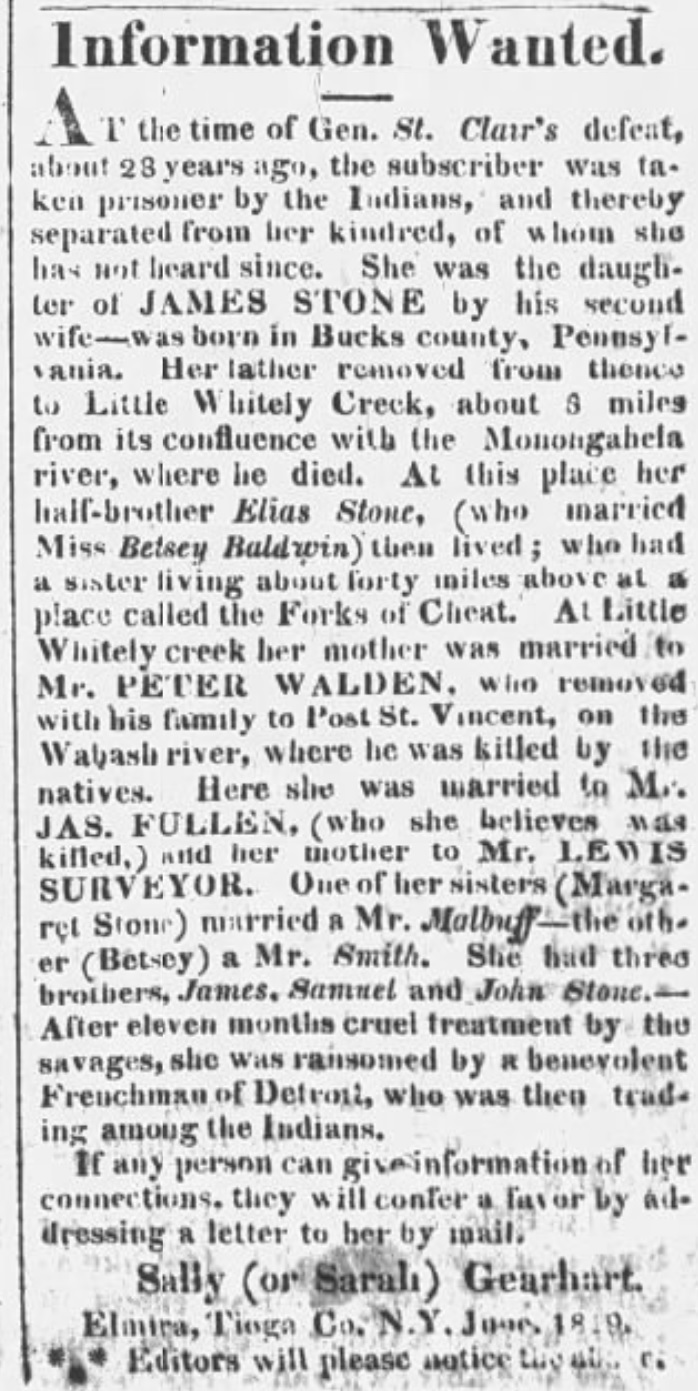
James Jr. later married and had several children.  The family then acquired property on Whitely Creek in Greene County where Priscilla was born four generations later.  We don't know the name of James Jr's first wife but she bore him at least one child, Elias Stone, my 5th great grandfather.  A second wife (name also unknown) produced five or six children.  Much of what we know of this family is mostly thanks to a newspaper article that appeared in the July 23rd, 1819 edition of the Susquehanna Democrat out of Wilkes-Barre, Pennsylvania.  

This really interesting article depicts the story of one of James Jr's youngest daughters. She would have been about about 47 at the time she had the article published.  It was an effort to locate and reunite with her Stone family relations.  She had been separated from them for almost 30 years.  So she enlisted the help of the newspaper to find them.

Her name was Sally Stone and she was born about 1772.  Her father, James. passed away while she was still young.  As she was Elias Stone's sister (actually half sister), she is my 5th great aunt.  Now widowed, her mother buried her husband James (likely) on Whitely Creek and subsequently married a man named Peter Walden. 

The new couple and the younger children (including Sally) moved west to Post St. Vincent (or Vincennes) on the Wabash River in what later became Indiana.  Elias Stone, who was much older than his sister Sally, did not move west but stayed in Pennsylvania.  He is documented as founding and laying out the town of Greensboro, Pennsylvania on property his wife had acquired during this time frame.  But that's another blog post.  

Back on the Wabash, things didn't go so well.  Peter, the newspaper indicates, was "killed by the natives" in the territory and Sally's mother married again to a man named Lewis Surveyor.

No specific dates are provided for their time in Vincennes but we know that General George Rogers Clark, accompanied by other family-- 5th great grandfather, Tobias Brashear and his brother Richard, took the town from the British in February of 1779.  I assume, Sally and family came along shortly after the Revolution had ended in 1782.  

Sally would have been of marrying age by about 1789.  She did marry at Vincennes to a local man named James Fullen.  I don't believe they were married long but it is noted by another source she had two small children by him.  

The newspaper article  says at the time of St. Clair's Defeat (Nov 1791) Fullen was dead and Sally was taken captive by the Indians.  The other source, a book called Heroines of Methodism published in 1857 states on page 192 that Fullen fell at St. Clair's Defeat and Sally as a young wife and camp follower, present at the battle, was captured by the Indians.  The book implies that Fullen may have been a civilian camp follower as well but I imagine he would have served the militia during that time.  On the day of the battle, however, they were all (men, women, and children) unwitting combatants.

The battle was an unmitigated slaughter.  St. Clair's Defeat or The Battle of the Wabash, is characterized as the most decisive loss in all of US Army history.  The casualty rate was 97.4%. 

 The following paragraph is taken from an article called "The Battle of the Wabash: The Forgotten Disaster of the Indian Wars" by Patrick Feng found here...  https://armyhistory.org/

The battle raged on for four hours. Women who accompanied the army fought desperately alongside the men and were also among the slaughtered. St. Clair finally ordered the camp abandoned, leaving behind the badly wounded and supplies, and led a breakout charge. Those who survived headed for Fort Jefferson. The rest were scalped, tortured, and murdered, including women and children. Of the 1,400 regulars, levies, and militia, 918 were killed and 276 wounded. Almost half of the entire U.S. Army was either dead or wounded in the aftermath of St. Clair’s Defeat.

The Indian combatants at the Wabash were a confederation of nations including Miami, Shawnee, Delaware and Potawatomi.  Descriptions of this battle stress an extreme level of callous brutality.  Custer's last stand did not happen for another 85 years and did not account for a 1/3 of the lopsided losses experienced at The Battle of the Wabash.

Sally was quoted by the newspaper saying she "believed her husband was dead."  This speaks to the chaos of the battle. She never saw his body.  Or if she did, she didn't have time to confirm if he was alive or not. No doubt all her efforts were focused on protecting her infants and herself.  She and one child survived the battle.  It is not known what tribe took her but she would spend many anxious months in captivity.  Her only remaining child did not survive the ordeal in the wilderness.  

After wandering the back woods with her Indian captors for 11 months, the party crossed paths with a French trader named Te Bo who paid a ransom for Sally and brought her to his home in Detroit where the Heroines book says she was "kindly treated."  Eventually she was carried East to the State of New York.

In New York she apparently was able to pick up life as usual.  She married again on the 13th of November, 1793 to a man named John Jay AcMoody.  They had three boys and one daughter before his death in 1806.

When she reached out to the newspaper in 1819 about finding the family of her childhood she was still living in Elmira, New York with a third husband named Tobias Gearhart and three additional children by him-- a girl and two boys aged 11, 9 and 6.  All her living children were born in Elmira.  She had 7 children between the ages of 25 and 6;  not counting the two she lost in the west.

I don't know if she found any of her Stone family as a result of her inquiries.  It's not clear if any of her full siblings were alive in 1819.  Her half brother Elias Stone was alive and still in Greene County, Pennsylvania according to the 1820 US Census.  I hope she was able to reconnect.  He passed away in 1823 at the age of  83.

Sarah died in Elmira ten years later at 60 years 9 months and 21 days according to her tombstone.  It's nearly unimaginable the things she experienced in her lifetime.  What a difficult world she knew, yet she persevered and was able to raise two families.  The Heroines book says this about her...

It is simply stated that for a number of years she was a believer in Christ; knew the power of the Gospel; loved the house of God; loved devotion, and died in the triumphs of faith.

Those words are reminiscent of the syrupy platitudes often found in older obituaries and books like this, but certainly there is truth in them.  This lady endured unspeakable horror and no doubt lived with it the rest of her life.  I'd say she had super-human inner strength. In my mind it could only have been divinely appropriated.

Here is the newspaper article as it appeared in the July 23rd, 1819 edition of the Susquehanna Democrat:


Here is Sally Stone in my Tree at Ancestry...

https://www.ancestry.com/family-tree/person/tree/47397879/person/192346095959/facts

Friday, February 24, 2023

A Memorable Sipsey Wilderness Trip


February 16, 2017 marked my 49th birthday.  It was a great week culminating with an enthusiastically anticipated trip to the Sipsey Wilderness Area in north Alabama with several guys from Church.  Sipsey has been a favorite hiking destination since I became familiar with it during my three boys’ scouting days.  I am not sure how many trips I had made to Sipsey before the ill-fated one described here– at least five.

Sipsey is beautiful.  The internet says it is 25,000 acres.  Located within the larger Bankhead National Forest in a hilly portion of northwestern Alabama, it certainly is wilderness.  There is no cell coverage within the whole network of trails.  But the hiking is great.  There are hardwood forested rocky hills, clear streams and a few waterfalls.  Arguably, it is the best hiking within a four hour drive of Jackson, Mississippi.


The weather was perfect that weekend.  I don’t know if Billy Dempsey had arranged for that, but he did manage to wrangle the Church van for our trip.  The seven of us headed out for Alabama Friday afternoon.  We overnighted at a hotel that night and landed at Thompson Trailhead about 11am on Saturday morning.  After a little hiking we found one of the preferred campsites along Sipsey Creek and made camp.


Jeremiah, Sebastian and Griffin


The next morning we decided to include a side hike to the big tree.  The big tree is supposedly the largest tree in Alabama.  It sits in a ravine or bowl-like area nearly in the center of the Wilderness Area--  a good five miles from the nearest trailhead.  During rainy times, there are a couple waterfalls that make the setting impressive indeed.  It’s a very big tree.  I can attest that it takes 7 scouts with outstretched arms to make a ring around it.


Along the trail


The trail to the big tree was still suffering the effects of a not-so-recent tornado.  There were many trees down across the path.  As hiking goes, it was moderately difficult.  At 2pm we were about 200 yards shy of the big tree.  After the umpteenth log crossing I came to three trees down in my path.  Instead of stepping between them, I ill advisedly stepped on top of one and attempted to hop over the other two.  My foot slipped and I went down pretty hard landing on my back and wedged between two trunks. I was dazed.  I remember looking up at Bill Hatcliff’s face who had been right behind me.  He had a pained look of anticipation as though he was about to hear a blood curdling scream. Stooped over with both hands outstretched he asked if I was ok.  


I remember thinking that I felt ok but something wasn't right.  I was looking at the bottom of my shoe when I should be seeing the laces.  My right foot had bent at the ankle towards the left until it was 180 degrees from normal.  It was obviously broken or at the very least horribly dislocated.  But oddly, it didn’t hurt.  The magnitude of my situation was slowly sinking in.  My head was a blur of,  “no, no, no ,no,  this isn’t happening.”   Before I realized it, my foot was put back in the natural position and sticks were tied to either side to keep it there.  I’m pretty sure Bill did most of that.


The other guys were all around by then.  It was clear our trip was over.  We won’t be seeing the big tree-- I needed medical care.  I felt terrible for bringing our hike to a screeching halt.  But there was nothing to do but face facts.  We needed to somehow get me the 5 miles out to our van at the trailhead.  


The first real pain I felt is when we sat me up to make an attempt at walking out with someone under both of my arms.  We didn’t get 2 steps.  Even the tiniest bit of pressure put on that ankle was excruciating.  I knew immediately that I was not going out vertically. 


There was a lot of discussion.  It was decided that two of our party would hike out and get help.  By then, it was about 3pm.  Billy and Sebastian Bjernegard hiked out.  Billy told me later he hiked about 18 miles that day in total.  It would be nearly dark before they made it to the trailhead and certainly dark for any return trip.  I figured a rescue team would wait for daylight before coming in after me so the remaining five of us got comfortable right there on the trail.  Griffin and Jeremiah made a small fire as it got dark and we ate some of our snacks.  At some point there was a visit from a scout leader whose troop had moved in and camped just down the trail.  They offered help but there was really nothing to do but wait.


It got really dark.  I was feeling pretty good so long as I stayed still. We just passed the time waiting for morning.  With the fire going it was almost like a normal night camping.  Then about 9pm we saw lights coming up the trail.  As they got closer, it looked like an army.  There were 15 or so EMT types climbing the hill.  Headlamps, fireman coats, heavy boots, helmets, radios and other gear.  We were very surprised to see them.  Billy and Sebastian had guided them in.


There was some shuffling around but the crowd seemed oddly quiet.  An EMT bent down and looked at my leg.  Not saying much, he sat down beside me.  That’s when I noticed nearly all of them were either hunched over with their hands on their knees or had sat down on the nearest rock or downed tree.  It dawned on me that they had just hiked 5 somewhat strenuous miles in full gear at night.  None of them had brought water.  None of them were wearing anything close to hiking boots.


I heard one of them attempting to radio back to the trailhead where they had set up a command center.  He gave up and announced there was no communication in or out.  Radios and cell phones just didn’t work this far out.


The guy sitting beside me called another EMT over and told him, “I hate to say this, but I don’t feel so good.”  Some of these guys were bigger than me-- and I’m pretty big for a hiker. I began to worry that my broken leg had fallen a few notches down our collective triage list.  There may be some heart concerns more pressing at the moment.  Our guys began dispensing water to the EMT’s.  We had to filter more out of the creek to keep up with demand.  


After a bit, the group got more talkative.  The reason for the big crowd became apparent when someone said the dispatcher had stretched the truth a little bit.  Speaking of my situation, he broadcasted something about an 18 year old cheerleader stuck in the woods.  That would also explain why they were so dejected at the moment.  


There was discussion about next steps.  Someone mentioned airlifting.  It sounded like a few of them were concerned that there was nothing for them to do. 


As they regained composure, a majority of them began heading back down the trail.  The crowd was thinning.  By 11pm there were only 5 of my rescue army remaining-- the crew with the orange plastic stretcher.  I was thankful because they seemed the most capable of getting my big self to the trailhead and waiting ambulance.  This remaining crew turned out to be the Moulton Alabama Volunteer Fire Department--  and they were a Godsend.


Chief Jolly brought some enthusiasm to the situation.  He was ready to move.  After getting me on board, they arranged themselves around the stretcher.  They used straps with the intent of dragging me down the trail.  One of our guys, Ken Seawright, would be our point man and keep us on the right path the whole way.


The first 100 yards or so were excruciating.  Every 6 feet we had another obstacle for me to go over or get dragged underneath.  I was in and out of the stretcher.  If I couldn't fit under a downed tree, I’d be set on top of it and my legs would get carried over.  Then I’d hobble back down into the stretcher.  Once we finally cleared the “Big Tree Trail” and got on the more traveled path things got better.  The ground was more even and the trail was more clear of obstacles.  


Ken, Matthew, Chief Jolly, Collis, Dwayne
and hiking buddy, Ken Seawright


Moulton can be proud of their volunteer fire department.  They worked extremely hard pulling me through Sipsey.  All of those guys are standouts in my book.  Collis, who introduced himself as “The black lumberjack,” had come straight from a Sunday evening Church service when he got the call.  I remember looking up and seeing his dark slacks and white dress shirt getting more and more dirty as the night wore on.  I hoped he hadn’t completely ruined his Church clothes.


Matthew was the young one.  I remember him debating whether he would go to class the next day.  Dwayne pulled like a madman and Ken would offer me water every so often even though I was doing nothing but watching the trees go by on my back.


They all kept their humor.  I was ribbed for having gone to the center of the wilderness area to break a leg.  “The rocks and trees look just the same at the trailhead. Why do you have to go five miles in?”


As the night wore on, we made some progress down the trail eventually getting within choppy radio contact with the folks at the trailhead.  It may have been about 3am at that point.  I heard the talk back and forth.  Airlift?  No, the Park Service won’t allow it unless it is life and death.  Chief Jolly says, “Life and death?  We could make that argument.”  The group decided to take a break.  We all tried to sleep.


Before daybreak the Moulton crew was back at it.  They were relentless.  I was carried over streams and dragged between boulders and around trees.  We made more progress.  Things felt much better in the foggy morning light.  Another EMT crew met us on the trail.  They had water and snacks. The closer we got, the better the radio reception.  We began hearing a helicopter.  I was not crazy about the idea of a helicopter ride.  How much would that cost?  Can they drop a basket through the tree canopy?


When we were about a mile out, the radio voices suggested that airlifting was now an option.  What did we want to do?  Part of me wanted this over fast but I still wasn’t crazy about getting lifted out in a basket.  Chief Jolly sealed it when he knelt beside me and said his crew had gotten me this far and it would mean a lot to them to carry it through.  You gotta respect a man with a mission.  Carry on!


We got off the trail about 10am.  There were numerous emergency vehicles at the trailhead and at least one news van.  We were told the helicopter we had been hearing was a news helicopter, not a rescue helicopter.  I briefly saw the rest of my hiking crew as I was put in the back of an ambulance.  The doors closed and I watched the scene get smaller through the back windows as we drove off.  The EMT slipped my shoe off and started cutting my sock.  The grossly swollen skin on my ankle was every color of the rainbow.  I took a picture with my phone.  


The ride out


As the ambulance maneuvered out of the wilderness and into the land of cell coverage, my phone began to blow up.  I got messages from people I hadn’t heard from since high school.  Apparently, the story had gotten out far and wide.  It must have been a really slow news day because my story made all the newscasts and print media outlets across several states.  Even today, a google search pulls up the story out of the Washington Times.  “Mississippi man rescued in Alabama forest after accident.”


I called my wife and gave her a rundown of the previous 24 hours.  Things were looking up.  My ambulance ride ended at the hospital in Jasper, Alabama.  Billy’s wife, Debbie, was there.  I  think she beat Billy and the guys if I remember right.  It was great to see a familiar face.  A couple x-rays later and I was in the Church van on the road home with a new boot, a pair of crutches and instructions to see an orthopedic surgeon as soon as possible.


In Jackson the next day, I found out I had broken my fibula (the smaller of the two calf bones) and a couple bones in my ankle.  Surgery was scheduled right away.  In the waiting room, I got a text from the wife of one of the scout leaders who had been just down the hill from us Sunday night.  No idea how they got my phone number.  They were thinking about me and wanted an update.  The number of well wishers was humbling and encouraging.  


I don’t remember much of the surgery.  They put a few pins in my ankle and a rod from just below my knee to my ankle.  The leg was closed up with 45 staples and I was scheduled for many months of physical therapy.  It took a full year to get back to normal.


Lot’s of time to reflect.  It’s humbling to be the one who’s down and out. You learn a lot in those times.   I generally don’t like attention.  My comfort zone consists of quietly maintaining the status quo somewhere under the radar and out of the line of fire.  


I was embarrassed at having been the one to ruin a great hiking trip.  Compound the extraordinary effort put forth by my hiking buddies and so many EMT types (some of them volunteers) all solely for my benefit and the crazy news coverage of my plight and you have a perfect brew for an introvert’s nightmare.  


I look back and hope I mustered up enough communicative skills at the time to show my appreciation for all the effort that went into getting me off the trail.  I thought about that a lot after getting back to Jackson.  Back in the surgery waiting room, I looked up the address of Dreamland BBQ in Tuscaloosa.  I had them send a full meal to the Moulton Volunteer Fire Department.  I hope that went a little way in repaying the favor.


Six years later, the surgery scar on my leg is almost unnoticeable and I rarely feel any evidence that there was ever any damage.   I’d call it 100% recovery.  I haven't been back to Sipsey, but I haven’t ruled it out either.


Wednesday, February 15, 2023

I think I found Polly

 Every now and then, I will check my DNA matches at Ancestry to see who's new.  This morning I noticed  a match from north Mississippi.  It's always exciting to get a "local" match.  My match is an 88 year old gentleman with an associated family tree of only 2 individuals.  We match 24cM across one chromosome segment and have over 100 shared cousin matches.  Thirteen of our shared cousin matches have a known (per ancestry.com) common ancestor with me.  Every one of those are McBride matches.  This is extremely good evidence that the most recent common ancestor shared by me and my 88 year old cousin is a McBride ancestor.  Unfortunately, his less than developed tree wasn't going to tell me exactly how we connect.

As I was up pretty early and had some time to kill, I created my own tree for this new match.  I wanted to find out how he ties into my McBride family.  He has a relatively unusual name so I was quickly able to determine his parents.  From there, I was able to knit together his tree to a great great grandmother on his father's side, Mary "Polly" McBride, born around 1815.   She married a William Hartsfield in Lauderdale County, Alabama in 1834.  There is our McBride match!

Everyone at ancestry who has Mary and William Hartsfield in their tree show Mary's father as Thomas McBride born in Tennessee in 1790.  Most then show Thomas' father as Hugh McBride (1770) of Bedford County, Tennessee.  I am familiar with Hugh and have pretty much determined his McBride's do not jive with mine except maybe way way back in Ireland or Scotland.  Previous DNA research has pretty much concluded that on this side of the pond, Hugh's family is not my family.  So, it is logical to me that my new match's great great grandmother's father is not the McBride who people are saying.

I looked at my own tree to see if I had a Mary "Polly" McBride born about 1815.  I did!  The last child of my 4th great grandfather, James McBride, was Mary "Polly" McBride, born about 1815.  My tree showed she did not live through infancy.  So does every other tree that has her.  But, now that I look in earnest, I can't find any record evidence that she died in infancy.  The only real evidence I have that she existed was a letter by 2x great uncle, James Louis McBride (1820-1905).  He names all of his grandfather's children...

...James was my granfather. His first wife was a Brock. She had 4 children before she died, 3 sons and 1 daughter, John was the oldest, was my father, next Sharword then William next Kisey (Kesiah).

My granfather second wife was a Jackson. She had 4 children 3 boys and 1 girl, Daniel, Jefferson and Solomon and Polly (Mary).

There was Polly- right at the tail end.  The letter doesn't say she died in infancy.  Nothing I can find says she died in infancy.  I think she is the Polly McBride that married William Hartsfield and here's why...


1. I have this DNA cousin match who is a descendent of Polly McBride Hartsfield (1814-1901).  He is certainly a McBride family match.  We share 24cM of McBride DNA.  Assuming Polly is who I think she is, my cousin match is a fourth cousin once removed.  Record evidence proves he is a great great grandson of Mary Polly McBride and William Hartsfield.

2.  My evidence for Polly's existence is a letter written by her nephew.  How many nephews would know the name of an Aunt that died in infancy years before he was born?  It's more likely that he knew his Aunt Polly.

3.  Polly married in Lauderdale County, Alabama at the same time (1834) my McBride's were living in Lauderdale County.  Specifically,  they were living 10 miles east of Florence, Alabama on the Tennessee River.  Sherwood McBride (mentioned in letter above), who I believe is Polly's half brother, patented property in Lauderdale County.  That property is now underneath Wilson lake.  Sherwood and Polly's father, James and James' second wife Sarah Jackson, were living on that same property with Sherwood from the 1810's to the 1830's.  

4. Shortly after 1834, the McBride family moved to various locations in Mississippi from Lauderdale County, Alabama.  The father, James and a daughter moved to Ripley, in Tippah County, Mississippi.  A brother, John, moved to what became Holmes County, Mississippi.  At the same time, Polly and her new husband, William Hartsfield, moved to Itawamba County, Mississippi (just across the State line).  By 1839, Sherwood McBride and his family were also living in Itawamba County.

5.  Polly who married Wm. Hartsfield was born at the right time to be the last child of James McBride and Sarah Jackson.  

6. Polly was in the right location to have been born to James and Sarah.  Polly's census records from 1850 to 1900 say she was born in Alabama.  Her marriage record is from Lauderdale County.  It is possible she was actually born in Lincoln County, Tennessee where James and Sarah were living before the move to Lauderdale County, Alabama.  But the move was right around 1814.  So conceivably, she could have been born at either location, but she would only have remembered Alabama, given her age at the time of the move.

7. None of the trees online that show Mary's father as Thomas McBride have any evidence of that relationship.  Thomas did live in Lauderdale County, but so did my McBride's.

8. Update:  Since posting this blog entry, I've found 3 other DNA matches who descend from Polly McBride & William Hartsfield and whose shared matches support the supposition that our connection is along the James McBride line.

So as a result of this foray into the trees of some DNA cousins, I have edited my tree to show Polly did not die in infancy but married William Hartsfield, had ten children and outlived her husband by 30 years.  She passed in 1901 while living with her youngest daughter in Johnson County, Texas.


Here is a link to Polly in my tree...

https://www.ancestry.com/family-tree/person/tree/47397879/person/24016321904/facts

Monday, April 11, 2022

The Iron Coffin

 A grave was being dug in 1963 when shovels hit iron.  Those digging were bewildered to find it was a coffin.  No burials were thought to be in that part of the cemetery.  It was buried only about 4 feet deep and oriented off axis. 

Shaped not unlike an Egyptian sarcophagus, the unusual cast iron coffin was tight at the feet and wide at the shoulders-- form-fitting so-to-speak.  A window at the head provided a view of the surprisingly well preserved deceased and his finely appointed clothing.  The construction of the coffin and the clothing seen within led to the assumption that the burial dated from the 1850's.  There was no marker or any other kind of identifying element.  None of the family-owned cemetery's board knew who this gentleman was or that anybody had been buried in that spot.   A mystery!   The iron coffin was exhumed and relocated a short distance away to allow for more burials. Eventually, it became largely forgotten.

Newspaper articles pick up the story when in the 1980's the mysterious iron coffin was dug up again.  This time it was sent to the Smithsonian in Washington D.C. for examination.  A Smithsonian forensic anthropologist had just happened to be in the area studying other graves and was contacted about the curious iron coffin.  Of the 400 graves he had been studying, none had contained an iron coffin.  This was unusual.

I had heard this story a few years ago and was mildly interested as it pertained to a cemetery with which I was becoming familiar in my genealogy work.  The Young Cemetery in Zachary, Louisiana houses many, many cousins and a few ancestors.  I'm a descendant of the Young family that founded it.  The cemetery is still active, is well kept and receives burials, as I understand, only from descendants of Judith and James Young, my 4th great grandparents.  I've made a couple brief visits to the cemetery in the past three or four years.

I was reminded of the iron coffin last week by double cousin, Ann Harang Haney.  I got a message from her on Ancestry.  She and I share the ancestors, Moses Guest on our mothers' sides and David Young on our fathers' sides.  David, a third great grandfather, is buried in the Young Cemetery.  She forwarded a news article about the iron coffin.  

The 1988 article mentioned that a study of the contents was conducted in D.C. the previous summer by the anthropology laboratory at the Smithsonian. The family was interested in finding the identity of the body.  To date, there were a few guesses, but no real breakthroughs.  Removal of the rusty lid revealed that there had been a considerable amount of damage to the contents since the 1963 disinterment.   The coffin had rusted through in a couple places.  Much had deteriorated.

Even so, the coffin and it's contents were still able to reveal some facts.  The deceased was male, who died in the late 1850's to the early 1860's.  He was in his 50's.  His clothing, including a black wool frock coat and trousers and distinctive black silk bow tie, were likely tailor made and popular from 1857 to 1865.  The coffin was unusual and no doubt expensive. He was wealthy.  The bones showed evidence of gout and arthritis.  The teeth were well worn.  There were 4 gold fillings.  All this info and still no identity could be determined.

It was the mention of gout that got me thinking.  I know someone who died down there who complained of gout.  My third great grandfather, Eugène Amédée Sherburne.  He died around that time.  As a matter of fact, he fits this case in many respects!  I had not found a marker for him the couple times I visited the cemetery.  His second wife is there, Patience Young Sherburne.  I took a photo of her gravestone.  The story from Virginia Lobdell Jennings' book, "The Plains and the People," stated E.A. Sherburne had been buried on his plantation "Fontania" on the river and at some point was moved to Young Cemetery when erosion threatened the original burial site.   

E.A. Sherburne died in 1860 at 57 years old.  He was a wealthy planter.  I have one photo of him and he's wearing a black bow tie.  His obituary in the local Baton Rouge Paper of Nov 17, 1860 reads, "The deceased had long been afflicted with that torturing malady the gout, frequently complicated with that other scarcely less torturing malady, rheumatism." 

Is it possible the mystery man in the iron coffin for all these years was my third great grandfather?  It seems plausible that a hasty reburial may be cause for the odd location and lack of marker at Young Cemetery.  I did a newspaper search for "iron coffins" in Louisiana.  The only other article I found mentioning iron coffins in the area was a May 10, 1958 article in the Alexandria Daily Town Talk titled, "Cenla Historical Society Tours Ante-bellum Homes."  The article mentions iron coffins at Live Oaks Plantation in Rosedale, Louisiana built by Charles H. Dickinson Jr..  "Located on the grounds is an old red brick church and a very old tomb containing odd shaped cast-iron coffins with windows provided for viewing the deceased."  I knew this place!  Charles Dickinson was a business partner of Eugène Amédée Sherburne. They were in the sugar business together until Dickinson's death in 1846, when his wife took over.  Sherburne continued the business relationship until his own death in 1860.  

There were too many coincidences not to dig further.  (No pun intended).  Wondering if there are more recent reports with more information or photos, I found the forensic anthropologist from the Smithsonian at their website online.  He is Douglas Owsley.  He still works there 34 years later!  I sent a short email to the address on his profile page but have not heard back from him.   Then, I called Alex McKowen, a distant cousin down in Zachary, and he gave me the name and number of a Young Cemetery board member.  Melinda Mills White (likely also a cousin) is currently Treasurer.  I talked to her on the phone and briefly explained that I was looking for a third great grandfather and was she familiar with the iron coffin?  "Absolutely," she said. She was present when it was exhumed that second time.  I told her my suspicions and she said she would run it by a couple people and get back to me.  

She called me back the next day.  "According to our plot map, your 3x grandfather is buried next to his second wife.  There is a  grave stone.  It is small and only has the letters E. A. S. on it."  I had missed that stone on my visits!  I guess I was looking for a larger, more prominent stone.  Melinda offered to send a photo of it when convenient.

So, it would appear, the iron coffin man remains a mystery.  He is not Eugène Amédée Sherburne as I had surmised.  All that excitement for nothing.  Eugène is accounted for-- next to Patience Young Sherburne.  I look forward to seeing the photo of his marker.

On the bright side, I now know where E.A. Sherburne is buried.  Find-a-Grave has him erroneously located in Washington Parish.  Maybe I'll send them an update.

Tuesday, July 13, 2021

A Grave Marker for Sgt. Samuel Sentell

Samuel Sentell's signature from his Pension Application.


Traffic in Atlanta on any given Wednesday afternoon is, by Mississippi standards, terrifying.  That's what I confirmed this past Wednesday as I travelled to Greenville, South Carolina for a wedding.  Adding another layer of difficulty to our driving experience in Atlanta, I  planned to briefly visit Arlington Memorial Park and Cemetery in Sandy Springs, Georgia.  Arlington is located just north of the 11 o'clock position on Atlanta's Perimeter road, I-285.  It was no small feat, but Karen and I eventually pulled into the cemetery unscathed.

I hoped to confirm if there was a grave marker placed for Nancy and Samuel Sentell.  Honestly, I wasn't entirely sure I would find them buried at Arlington.  Nearly all indications online were pointing to the adjacent cemetery at Sandy Springs Methodist Church.  

Who were Nancy and Samuel Sentell?  They were a young  couple at the close of the Revolutionary War.  Sgt. Samuel Sentell was just back from his last tour of duty when they married in 1782.  A Baptist minister, Thomas Harvey, performed the ceremony in Halifax County, North Carolina.  Nancy was a daughter of Halifax County, but Samuel was a son of Brunswick County, Virginia.  

The family was of modest means- a trait that carried down to Samuel, the subject of this post and my 4th great grandfather.  Samuel's great grandfather was a Huguenot refugee, also named Samuel, who settled in Virginia around 1700.  Later in life, the elder Samuel hung up his farming implements and is recorded in vestry records as having served as custodian of the Old Blandford Church which is still standing in Petersburg, Virginia.  See the Church wiki page here.  By the time of the younger Samuel's birth, the family had migrated another 60 miles south along the Fall Line Road.  Then, by the outbreak of the War, Samuel enlisted out of Halifax County North Carolina. 

Samuel and Nancy have a fantastic Revolutionary War Pension record.  In it, Samuel detailed 4 tours of duty with North Carolina troops.  He served from 1777 off and on until his discharge in April of 1782.  In one tour he marched from Halifax County, North Carolina to Philadelphia and then to West Point, New York where he helped in the construction of fortifications until weather set in at which time they marched back to Philadelphia and wintered there.  On another tour, during the Battle of Eutaw Springs, he suffered a severe wound to his left breast which he states, "rendered me incapable of further duty for some time."  Samuel served with the rank of Sergeant for much of his service.  

After Samuel's death in 1844, Nancy, at age 83, applied for a pension due her in light of Samuel's service.  In that document, Nancy included the names and birthdates of all 10 of her children.  She also named her father.  Nancy lived considerably longer than Samuel filing her will in 1860.  She filed in DeKalb County, Georgia after having lived there for 23 years.  In it, at age 98, she left her whole estate (likely meager) "both real and personal forever and in fee simple with all the rights members and appurtenances to the same..." to Leonidas F Heflin.  He is also named executor.  Leonidas Franklin Heflin was married to one of Nancy's granddaughters, Henrietta Cardin.  Nancy lived with them after Samuel's death.  After Nancy's death and the death of Henrietta, Leonidas married another of Nancy's granddaughters, Frances Reynolds.

So where are Nancy and Samuel buried today?  Earlier sleuthing by distant Sentell cousin, Ann Crichton, helped me uncover the details.  A few years ago, I found that Ann had posted a story and photos on Ancestry.com describing the exhumation and reinternment of Nancy and Samuel Sentell.  Ann had spoken with some Atlanta area DAR ladies who were interested in marking Samuel's grave site as he was a Revolutionary War Patriot.  It was disappointing that a Revolutionary Patriot had never had a proper headstone.  I'm interested in having him memorialized as well and it is the primary reason for chasing down this story.  One day, I would love to see SAR and DAR patriot grave markers by his headstone.  But first, we need a headstone!

The DAR ladies told Ann about the original grave site;  that it was located at Sentell Baptist Church on Roswell Road in Sandy Springs.  Five graves had been exhumed in 2003 and reinterned at Sandy Springs Methodist Church Cemetery due to some paving/ roadwork needs at the Sentell Baptist Church.

Rita Cheek, a Sentell descendant, prepares the reinternment in 2003.  
Photo posted at Ancestry by Ann Crichton

Prior to 2003, the cemetery had sat idle for decades.  There is no way of knowing for sure, but we can assume the Sentell family cemetery's earliest burial was Samuel himself in 1844. This was a small family plot on a typical family farm.  Samuel's 49 year old son, Britton Sentell was buried there 2 years later.  Nancy passed away about 1860.  She was likely buried next to Samuel.  The original stones in the small cemetery did not provide any information at all about those interred.  They were described in a 1931 interview as "rough uninscribed field stones" by J. Franklin Burdett, a 90 year old citizen of the area. As many as 11 burials eventually filled the small cemetery; most of these being unknown family members.

Some time later saw the addition of an adjacent Church building.  Sentell Baptist Church was presumably named for family members who donated the land and were members of the congregation.  The cemetery predated the Church.

The photo above, sent to Ann Crichton, shows Rita Cheek in 2003 preparing a small coffin for reburial.  Ann sent me a copy of an email from Marlene Wall to Sam P. Sentelle that relates the following...

Sam,

This is a picture of Rita Cheek getting the coffin ready to put the remains of the 5 bodies in this small casket.  She had gone in with the grave diggers and lay on her stomach and unearthed the remains as they showed her what was left.  It was not very much, but she wanted to do it herself.  The five were put into this small coffin and the coroner, lawyer, Rita, myself and the grave diggers went to the cemetery and they buried it in the left bottom corner of her parents grave plot.  The entire thing took from 9 in the morning until about 4 in the afternoon.  What an experience!

Marlene

How I wish I had been there for the exhumation.  It is said that Samuel carried a musket ball in his left breast from Eutaw Springs.  I would have made an concerted effort to find that piece of lead.  It probably wouldn't  be right to keep something like that, but I would have certainly made a wax impression.

Another photo Ann turned up shows the front of the now demolished church...


That small coffin containing a few remnants of bone from 5 burials from the cemetery at Sentell Baptist Church was reburied at the plot of Warren J. & Margaret W. McDonald (Rita's parents) at the Sandy Springs UMC Methodist Church cemetery next door to Arlington.

Ann Crichton posted this photo of the unmarked location where the small coffin is located today...

Ann Crichton's photo of the Methodist cemetery grave location

Believing Nancy and Samuel were buried at Sandy Springs UMC, I called the Church office and eventually got the number of Carlton Smith, chair of the cemetery committee.  We talked by phone in July of 2020.  Though attending the Methodist Church now, he had been a member of Sentell Baptist Church in his youth.  He knew the family but was not knowledgeable of the particulars of the reburial of Samuel and Nancy.  He contacted Helen Sentell Gilliland who he knew had been involved in the reinternment and sale of the Church property.  He gave me her number, but I have been unsuccessful in all attempts to contact her.

Mr. Smith seemed unaware of the 2003 reburial.  He informed me that he was told Samuel and Nancy were not buried at the Methodist Church, but they were located next door at Arlington Memorial Park and Cemetery.  He relayed how Sentell Baptist Church had closed it's doors.  The building survived as a daycare for a time but even that fell through and as of 2015 the building was gone.  

Mr. Smith described that sometime around 2015 the city (Sandy Springs) began a right of way and street widening project and offered to pay for the exhumation, reburial and a new marker for all the graves in the Sentell cemetery.  The city bought a lot at Arlington Memorial Park and Cemetery for the Sentell burials.  This didn't jive with the story of the reburial I found online.  For one, they were off by 12 years.

So, it turns out, there were two exhumations and reburials.  Five of the graves were reinterred in 2003 at the Methodist Church and the remainder were exhumed and reinterred in 2015 at Arlington.  I don't know how either party could have known conclusively which Sentell's they were exhuming.  We can't know for sure who is at either cemetery.  

It was clear there was no marker at the Methodist Church, but no one could verify if grave markers were ever provided by the city at Arlington Memorial Park and Cemetery.  This is what I wanted to confirm as I visited Arlington.

The Arlington Cemetery office was on the left as we entered the property.  I went in and met Felicia Kelley who very helpfully provided some more bits of info after disappearing into a back room of the office to dig through some files.  She indicated the Sentell plot would be found in Monument Section 1-1 on the easternmost edge of the cemetery property.

Nancy and Samuel are in Monument Section 1-1

More specifically, they were located in the southern half of Plot 18 of Block 7.  I snapped a photo of the plot map...

Ms. Kelley pointing to the Sentell grave locations.

Ms. Kelley said her file showed a marker had been designed but she could not verify if it was installed.  I'd have to go out in the cemetery and try to find it.

I drove to the section and got out where I thought I'd be close to Plot 18, Block 7.  I searched the surrounding markers for "Sentell" but found none.   There were not many markers back in that area.  It was becoming apparent that no marker existed for my Sentell family.  Pinpointing plot 18 was not easy.  There are occasional little round concrete unit markers flush with the turf that denote plot corners.  Most of these have become buried or don't exist but I found one or two that helped me  get close enough that I could confirm there was no Sentell marker.  

Corner Marker two plots west of the Sentell plot

Block 7, Plot 18 is almost on the tree line.  The area denoted by the plots in green on the plot map above is heavily wooded.  I spooked a healthy looking doe as I searched the area.  A little while later one spooked me as I poked my head into the bushes to confirm no markers were behind the tree line.

Turns out this location is within 400 feet of the spot where the little casket is buried at the Sandy Springs Methodist Church cemetery.

The Sentell Marker should be near the tree line behind the "Fry's" marker here.

I went back to the office and relayed to Ms. Kelley that no marker existed for Nancy and Samuel Sentell.  Sentell's had been buried at Arlington for 6 years with no marker at all.  She told me a coworker who was around back then would likely have more info but she was out that day.  Ms. Kelley would follow up with the coworker and get back with me.

After continuing my trip to Greenville, witnessing a successful wedding, taking a subsequent side trip to Hendersonville, NC, admiring the views at Jump Off Rock and returning all the way to Jackson, Mississippi, I emailed Ms. Kelley.  She replied with the following...

Hi John,

I did speak to Kelly and she gave me this information to pass along to you.

The City of Sandy Springs has already paid for the monument, and it has already been designed. The monument just needs to be approved by the City Manager.

The last number we had to reach them is (770) 730-5600. The City Manager that was in charge has since changed.

Perhaps a gentle nudge from a descendent of Sgt. Samuel Sentell will be just what the City of Sandy Springs needs to approve the monument so we can submit it for production.

I hope this was helpful.

It was helpful. I called immediately and spoke with Caroline in the Sandy Springs City Manager's office.  I recounted everything I knew to date regarding the missing grave marker of Nancy and Samuel Sentell.  She took my information and promised to get back with me.  That was Monday, July 12, 2021.

I found out in a subsequent call to Ms. Kelley that the design for the grave marker was sent over to the City of Sandy Springs for approval on September 26, 2016.  Ms. Kelley sent me the proof for the memorial stone that was sent to the city...


On July 30, 2021, I called Caroline with Sandy Springs again and gave her the date info and asked if it would be helpful if I emailed the proof file.  We exchanged emails and I sent the items over with an offer to help in any way possible.

On August 26, 2021, I sent a follow-up email to Caroline and received an automated email reply that she no longer works for the City of Sandy Springs.  The email instructed that I contact Samantha Dulac for assistance.  Samantha is the new Assistant to the City Manager.  I sent an email to Ms. Dulac and asked about the status of our approval after a brief explanation of where we were to date.

After lunch that day, I received the following from Ms Dulac...

Hello Mr. McBride,

Thank you for bringing this to my attention. I apologize for the delay; Caroline no longer works for the City.  Deputy City Manager Dave Wells has signed the document, and Director of Public Works Marty Martin provided the signed document to Arlington today. I will attach the signed copy here as well.

Thank you very much and have a great rest of your day!

I later confirmed with Felicia, at Arlington Cemetery, that they had received the signed document and the stone was indeed now in production.  It will be several months, but there will finally be a stone for Nancy and Samuel and family.

The city and the cemetery apparently know nothing of the previous reinternment of 2003.  According to them, 11 graves were reinterred at Arlington and they include Samuel, Nancy, Britain and 8 other unknown Sentell family members.  

I had a thought to have the small coffin reburied at Arlington or get the verbiage changed on the headstone design to better reflect the questionable nature of the actual occupants of the new lot, but this would be costly and time consuming.  We would have to go through probate to verify who had authority to move the small coffin.  It took six years to get the headstone in production.  Changing the verbiage now could delay it who knows how long.  

In the end, I'm ok with getting a Sentell headstone that may not be entirely accurate.  I think it's close enough.  Samuel, Nancy and Britain deserve a headstone even though it may describe remains some 400 feet away. We will never know which Sentell's are in the little coffin and which are buried at Arlington Memorial Park and Cemetery.  But in a few month's time they will all have a respectable monument and it was a long time coming!

November 2022 Update:  The delivery and installation of the Sentell family headstone at Arlington has been confirmed!  Thanks so much to cousin, James Sentell. for running down a photo of the new headstone and updating the Find-A-Grave memorial page for Samuel.  You can see the photo and James' handiwork at "Find A Grave" here...  https://www.findagrave.com/memorial/73916403/samuel-sentell

Tuesday, October 6, 2020

Jonas Carle

There's a man buried in a now defunct cemetery just north of Baton Rouge who was involved in cattle rustling, rampant looting and general skirmishing while ostensibly gathering military intelligence in and around New York City during the American Revolutionary War.  He served as a Lieutenant in a brigade famous for being especially adept at guerrilla warfare.  They roamed the countryside of New York wreaking havoc.  But we can't attribute his actions to American patriotic fervor.  This man was fighting for King and Country.  His service was in a British provincial unit.  He was a New York born Loyalist.  He is 5th great grandfather, Jonas Carle.

Jonas was born in 1761 in Dutchess County, New York.  The family referred to the area as the Fishkill mountains. The town of Fishkill is still there, but the mountains around there are generally known as the Hudson Highlands today.  Jonas was born and lived within those mountains somewhere near the town of Fishkill.

Jonas began his military service about 50 miles downriver, at Morrisania, New York.  He signed on with Colonel James DeLancey- known derisively by Patriot neighbors as the "Outlaw of the Bronx."  Jonas later wrote in a land petition that he served under DeLancey from 1777 "until the peace" (about 5 years service).   The brigade was known as DeLancey's Cowboys.  This is partly because many of the unit consisted of mounted dragoons but mainly because they spent a lot of time rounding up cattle for the victualing of the British army stationed in  New York City.  Cattle from Patriot farmers were outright stolen, while Loyalist farmers received what compensation was available. You can see what the cowboys of Jonas' unit probably looked like HERE.

Jonas' claims indicate he served as one of DeLancey's lieutenants.  Not much is known about his specific actions during the war but we know the brigade  generally remained in and around Westchester County which is where most of them were born.  The following is taken from James DeLancey's resignation letter and gives a good overview of what they were up to...

The Memorial of James DeLANCEY of West Chester County Esquire.

Most humbly showeth,

That your Memorialist has, from the very Commencement of the present Controversy between Great Britain & America, evinced the most zealous & unequivocal Attachment to his Sovereign & the British Constitution, & since the Year 1777, has commanded the Militia & loyal Refugees in the County to which he belongs- a Corps consisting of five hundred Men, who, as well as your Memorialist, have served without either Pay or Cloathing.

That by Means of their Service, the Enemy has been constantly kept at such a Distance from King’s-Bridge, as to render that Post perfectly secure, & to keep up a Communication with the Country People for the Supply of the Magazines & Markets at New York.

That the Enemy have been repelled in every Attempt to destroy the People under your Memorialist’s Command, & that in the many Engagements which he has had with them your Memorialist has been so fortunate as to capture a Number of Prisoners sufficient not only for the Exchange of his own Men, but also for the Release of above five hundred British Prisoners.

That your Memorialist has in the Course of his Services, repeatedly received the Thanks of the Commander in Chief & of those General Officers under whom he has had the Honor to serve.

That he has always endeavoured to maintain the strictest & most exemplary Discipline in his Corps, & has gone in that Respect much beyond what has ever been practised in other Bodies constituted in a similar manner.

That your Memorialist has at all Times exerted the most anxious & unwearied Attention to preserve the Property of the Inhabitants in the Country & afford them every Protection, by which means he is well convinced that he has acquired & maintained the firm & general Attachment at least of such of them as were loyally disposed-...

At the close of the war, like many Loyalists, Jonas sought refuge in Canada.  From New York City, it would appear he and his father traveled by boat to St. John, Nova Scotia (now New Brunswick) and remained there a couple years.  By that time he was about 24 years old. 

It's possible Jonas had married.  An article by Dr. Esther Clark Wright appearing in a New Brunswick newspaper sometime in the 1970's was titled "Pioneer Families of New Brunswick."  The article relates the following...
Among the Loyalists who came to New Brunswick in 1783 were three men of the name Carle, Jonas, Robert and Thomas...   ...Jonas and Robert may have been brothers of Thomas, but there is no record of their relationship.  

Jonas received a grant of Lot 827 in Parrtown, on Bulkeley Street, and also of lot 12 on the east side of the Long Reach.  Jonas Carle seems to have become involved in transactions connected with Lot 12; while the St. John River was still part of Sunbury County, Nova Scotia, he bound himself to Gershom Fairchild for £250 to convey Lot 12 to the latter; in May, 1785 he and his wife, Amey, conveyed half of Lot 12 to John and Jacob "Britney" for £18, 15s; in August, 1785, Amey Carle asked for Provisions stating that she had been two years here, that her husband has "Been gone from her near six months past and she was left destitute of Friends."  There is no further light on the fate of Jonas and Amey Carle.
This was the first I had heard of a possible first wife of Jonas Carle.  I also found it curious that there was no mention of James Carle, Jonas' father, in the article.  There were some 15,000 loyalists that evacuated the fledgling USA for New Brunswick between 1783 and 1785.  It is conceivable there were a couple "Jonas Carle's" among the Loyalist settlers.

The timeline is important here.  Amey's petition implies that she came to New Brunswick around August of 1783 and that her husband Jonas left New Brunswick in March or April of 1785 (been gone six months past).  Begs the question, how did Jonas bargain over Lot 12 in May of 1785 when he was "gone" two months prior?

But the land petitions of his father, James, seem to corroborate the newspaper article's claim about Jonas having a wife named Amey.  The following petition mentions the lots described in the article and the transactions with the Fairchild family...

RS108 Land Petitions James Carle 1785

To His Excellency Thomas Carleton Esquire Captain General and Governor in Chief of the Province of New Brunswick
yea yea yea

The Petition of James Carle

Humbly Showeth
That your Excellency's Petitioner having had a tract of land assigned him lying on the little Kennebecasis No. 56 it being at a great distance from water Carriage and having a large family made an exchange with his son Jonas Carle, for farm No. 33 on the Great Kennebecasis which farm is said to be within the limits of Sir Andrew Snape Hammond's grant, and which farm your petitioner's son Jonas Carle obtained from Alexander Fairchild by giving said Fairchild a farm which he drew on long ____ ____ ___ with Thirty Dollars for the same-

That your petitioner is in possession of the farm No.33 on the great Kennebecasis and  has built thereon and cleared ___ ____ ____ tract of land.  Your petitioner therefore humbly requests that your Excellency would be pleased to make a grant to your petitioner for said farm No.33, if it should be given up by Sir Andrew S. Hammond for the benefit of the ____, as your petitioner is the first Occupant and put all his little substance in building and _____ the land, on said farm, and as in Duty Bound petitioner will Ever Pray.

James Carol (signature)

City of St. John 1st June 1785
This petition spells out the father son relationship between James and Jonas. I have not found a land record that names both Jonas and Amey.  The sale mentioned in the article to John and Jacob Britney would be a good one to find.

We know Jonas did leave Nova Scotia after a couple years.  I suspect he chased Gershom Fairchild back into New York when he realized Gershom had swindled him.  When he made the return trip to his old home in New York, he found his old neighbors less than charitable.  He was promptly arrested and thrown in prison. This may explain why Amey was left destitute.  Jonas couldn't get back to her.  The ordeal is described in another of the land petitions he wrote after later (again) fleeing to Canada.  In Jonas' words...
I was taken up by the people in the State of New York and put into a dungeon and there close confined for nine months & afterwards stripped of every thing, being glad to escape with life to this place, owing to being thus plundered, being so reduced in circumstances, your Petitioner has been obliged to remain here.
"This place" was Upper Canada.  The Niagara region of Ontario.  I find it strange that there is no mention of his family or wife in Nova Scotia in the documents that are associated with his time in Upper Canada.  Why did he  go to Upper Canada instead of going back to Nova Scotia where his wife was waiting?  He says he was reduced in circumstances.  I think the charitable answer is he couldn't afford to get back to Nova Scotia.  Otherwise it sounds like he abandoned his first family.  It's possible Amey had passed away while Jonas was in jail.  I've found no other evidence for Amey and have no way of knowing for sure what happened to her.

With officer status Jonas qualified for a fair amount of property.  Now in Upper Canada, he filed again for land grants.  The land petitions give us the best evidence for his life and actions during and after the war.  The following petition confirms his officer status...

An image of one of Jonas' petitions for a land grant.

The text of the petition reads as follows...
To His Excellency John Graves Simcoe Esq.  Lieut. Governor of the Province of Upper Canada Commanding His Majestys Forces therin    In Council    The Petition of Jonas Carle Humbly Showeth    That your Petitioner is desirous of settling the lands allowed to him by His Majesty for his services as an officer in Col DeLancy's late Provincial Corps--  Therefore Prays that he may have two hundred acres-  and your Petitioner as in duty bound will ever Pray- Jonas Carl    
Newark 18 Oct 1794   
Granted__
The document indicates it originated in Newark.  This was the prior name of the town of Niagara On The Lake, Ontario.

Jonas settled near 20 Mile Creek in an area known as Caistor on the Niagara Peninsula, Upper Canada Province.  This settlement is about 28 miles west of Niagara Falls.  By 1788 (the actual date, I am not sure), he had married another American-born Loyalist, Rachel Johnson, whose father, Jeremiah, also served the crown in his majesty's loyalist forces.  Unfortunately, Jeremiah Johnson (a 6th great grandfather) did not survive the war.  A Heir and Devisee Report stated that he was "...killed by the Americans in the late war."  Jeremiah had married in the Dutch Reformed Church of New York to Phoebe Brown.  Rachel was their first child, born in 1766.

Rachel had several siblings. One younger brother named Henry married Dolly Merritt.  The Merritt family, before the war, were neighbors of Jonas Carle in the Fishkill mountains of Dutchess County, New York.  They would have likely known of Jonas' first wife, Amey.  This was a large family, some of whom, like Jonas, had served under DeLancey but most had served under John Butler in "Butler's Rangers."  After the war, the Merritt's settled near Jonas on 20 Mile Creek but in spite of Jonas being an early settler in the area and likely because they outnumbered him, the settlement became known as Merritt Settlement.  Rachel's mother, the widow Phoebe Brown Johnson, followed her daughter to the Merritt settlement and eventually married John Wrong of Barbados.  Phoebe's grave can be found at the Merritt Settlement Cemetery near Smithville at Grimsby Township, Lincoln County, Ontario.

One of the Merritt's left a diary of sorts that mentions Jonas Carle.  Special thanks to Gail Woodruff of the United Empire Loyalist Association of Canada for relaying this info to me.  The diary's author was a grandson of Henry Johnson and Dolly Merritt Johnson.  It quotes his mother, Eunice Johnson Sharp,  
Mother says her grandfather, Joseph Merritt, came from Fish Kill Mtns., NY, settled at 20 Mile Creek (later Merritt’s Settlement) because Uncle Jonas Carl (Carol) was settled in Caistor nearby.  Carrol had an illegitimate son living down about where Port Robinson is now.  Mother thinks his name was “Archie”.  Mother says Carrol was a fine looking man.
It's possible, Archie was born before Jonas' marriage to Rachel.  I have not found any evidence for Archie as of yet and do not know when he was born.  Illegitimate son aside, Jonas and Rachel had at least seven known children. They include Sarah, Eliza Ann, Phoebe, John, Judith, Eunice and Henry.  All of these children were born in Upper Canada Province on the Niagara Peninsula.

Jonas was successful with his land petitions.  He was awarded at least 2 grants.  One was located along the Niagara River about 8 miles upstream (south) of the falls.  I'm a little doubtful he ever lived there as the Merritt family identified his home as the old Josiah Nelson Farm.  It seems most of Jonas' activity was around the area of Caistor.

Another local diary records that Jonas was part owner of a sawmill on 20 Mile Creek. He had half ownership of the sawmill.  The agreement with his partner required Jonas to build the saw mill 42' x 26' with two saws, 2 water wheels, 2 carriages and a log way 25 feet long for 80 pounds New York currency, 1 barrel of 208 lbs pork and 3 cwt. flour.  Jonas was to haul all lumber, furnish all boards, planks, blacksmith's work and do all the digging.  The mill was to be completed by November 7, 1793.  With this we learn that Jonas' trade was likely builder/ craftsman.

1798 is the date of the last Canadian document we have for Jonas Carle but his youngest child, Henry, claims in his 1850 and 1860 US federal census listings that he was born in Canada in 1799.  So it follows that some time after 1799 Jonas left Canada as all subsequent documents show him south of the border.

In 1805, Jonas, Rachel and their children show up in the Louisiana Territory.  Jonas removed his family from their Canadian home, ventured down the Ohio and Mississippi Rivers via flatboat and bought at least 3 properties in the newly acquired lands of the Louisiana Purchase.  He acquired 640 acres right on the north bank of the Missouri River about 5 miles east of what is Jefferson City, Missouri today.  The property is in Township 44 North, Range 10 West from the 5th principal meridian. 


As a point of reference, in May of 1805, when Jonas owned this property, Lewis and Clark and the Crew of Discovery passed right by in their keelboat and canoes working their way up the Missouri River on the first leg of their famous expedition to the Pacific and back. They would have certainly laid eyes on Jonas’ land adjacent the river and, who knows, maybe even Jonas himself. However, it is my suspicion that Jonas’ purchase of this particular property was purely speculative and he may not have spent much time there if at all. 

The other  two properties he is credited with in the upper Louisiana Territory were found on Lake St. Marie in the New Madrid district.  I have been unable to verify their exact location. That lake disappeared as a result of the massive earthquake of 1811.  The surveys for the properties indicate they were about 13 and 22 miles north of New Madrid, respectively and about 1,000 arpents in total.  I imagine this is where the family was living- if not in the settlement of New Madrid itself. 

Jonas' name appears among the signatures listed in an 1805 document known as the "Gov. Wilkinson Memorial."  This listing was taken from people living in and around St. Louis, St. Genevieve, New Madrid, St. Charles, St. Ferdinand and Cape Girardeau. This memorial Jonas signed was actually a collection of letters signed by residents in support of Governor James Wilkinson who in 1803 had been appointed Governor of the Louisiana Territory above the 33rd parallel.  Wilkinson had been amassing a fair amount of bad press.   In hindsight we know that bad press was not undeserved.  Meriwether Lewis would eventually replace Wilkinson as Governor when President Jefferson could no longer ignore the possible acts of treason that tarred Wilkinson and his government.

By February of 1810, The Carle family had moved again.  Jonas is found in the Spanish West Florida Records where one document indicates he purchased two parcels of land in the town of Baton Rouge.  Jonas bought lots 6 and 7 of block 19 from Barthelemy Beauregard for five hundred pesos.  Beauregard was administering the estate of his father, Elias Beauregard who had passed away the previous year.  

Elias is well known for having developed the grand Baroque urban plan designed to be the heart of the fledgling city of Baton Rouge.  Born in Louisiana of French origin, Elias rose to some prominence in the Spanish militia.  For a time he was Commandant of the fort at Walnut Hills, where Vicksburg is today.  His brother, Michael, was the grandfather of General P.G.T. Beauregard who is known for having served the Confederate States during the Civil War.  

Elias had the elaborate urban development designed by French born Architect, Arsene LaCarriere LaTour, in 1799.  LaTour would soon most notably become the architect of Andrew Jackson's defenses at the Battle of New Orleans. 

"Beauregard Town," though not fully implemented as originally drawn, is the second oldest neighborhood in Baton Rouge-- after Spanish Town.  Now, it's an historic district found on the National Historic Register. Most of the street names there today still reflect those of  LaTour's original plan.

This image shows about a quarter of the original plan drawn by LaTour.  I have highlighted various properties owned by Jonas Carle.

Jonas' various properties in "Beauregard Town," Baton Rouge ca. 1810-18

The lots on blocks 34 and 23 were sold to Jonas' son-in-law, Isaac Townsend in 1818 for six hundred dollars.

In 1811, another land sale document shows Jonas agreeing to build a house as payment for additional property.  This document is interesting to me because of the descriptive instructions for the construction of the home...
...The present sale and conveyance is made for and in consideration of the sum of one dollar in hand paid, the receipt whereof is hereby acknowledged, and for the further consideration of the materials and workmanship of one house to be furnished and performed by the said Jonas Carl at the time & place & of the form and description following that is to say the house to be thirty six feet long, eighteen feet wide and of one story ten feet in height with a gallery back twelve feet wide the whole length of the house, and a convenient room on each end of the said gallery, the joist of both floors to be nine inches in width, the house to be weather-boarded on all sides with cypress plank of a proper thickness, and covered with cypress shingles eighteen inches long- the flooring plank, not to exceed eight inches in width.

The frame and all wooden materials to be furnished by said Carl, and to be sound and of good quality;  the openings to be not less than sixteen that is to say five windows of twenty four lights each, four of eighteen lights each, and seven doors the said openings to be made, by said Carl and also the sashes window shutters and doors - the whole work of said house to be done in a plain workmanlike manner, and completed on or before the fifteenth day of September next after the date hereof, and on such lot in the town of Baton Rouge as the said Edith & Richard or their agent or attorney may designate.  The said Carl not to be delayed for the foundation or any of the iron materials to be furnished by the said Edith and Richard.

The description sounds a lot like the typical planter's cabin going up all over the south at that time.  There are a number of examples still around.  The following photograph is one in Baton Rouge and it is about the same size as described, though the gallery, as is typical, appears on the "front" instead of the back...

I'm curious about the phrase, "one story ten feet."  I assume that means there is a first floor and then an upper floor extending another 10 feet.  The description goes on to say "the joists of both floors to be 9 inches in width."   It seems fairly evident that the house Jonas was contracted to build was two stories.  This document makes it appear that Jonas continued to make a living through construction in the Baton Rouge area not unlike his work on the Niagara peninsula.

As a side note, it is interesting that all of the documents referring to Jonas in Canada, include an "e" at the end of "Carle."  Sometimes the early documents spell it Carol or Carroll.  When he moves south and especially  after 1800 or so, the "e" is dropped.  It is also evident none of his children utilized the "e."

The aforementioned children of Jonas and Rachel Carl all made the trip to Baton Rouge.  The connection from Jonas to myself is as follows...  Jonas and Rachel's daughter,  Phoebe married Isaac Townsend in 1813.  Their daughter, Eliza Ann Townsend married David Young.  Their daughter, Patience Elizabeth Young married Charles Brashear Sherburne.  Their daughter, Eliza Ann Sherburne married Nathaniel William Sentell and they became the parents of my paternal grandmother, Annie Lou Sentell.  

The United Empire Loyalist Association of Canada (UELAC) offers a certificate for those that can prove lineage from one of the original Loyalist settlers.  I am working on that certificate for Jonas.  Somewhat similar to the Sons of the American Revolution (SAR), the UELAC consists of chapters.  These chapters are scattered all over Canada.  I chose to join the Colonel John Butler (Niagara) Branch because that's the area where Jonas' grant lands were situated and where he started his family.  As already mentioned, Jonas had friends and in-laws who were members of Butler's Rangers.  

Also like SAR, there is an application process.  At SAR, I had the work of my mom to piggyback on.  Here, I'm starting from scratch.  As far as I can tell, no one has ever attempted a UELAC certificate for Jonas Carle.  That plus the unbroken line of female ancestors between my father and my Loyalist 5th great grandfather has made proving the lineal descent from him very difficult. Female ancestors, require proof of their birth parents, but also their change of name (marriage).  I'm told by the extremely helpful, Wendy Broda (Col. Butler branch genealogist), each application must survive the scrutiny of the Dominion Genealogists who examine the facts and every bit of evidence presented while holding fast to a rigid set of genealogical guidelines.  This makes the process difficult but, I hope, ultimately rewarding. 

The most difficult part, in my case, has been finding documentation for the early generations.  I need to prove Phoebe Carl was Jonas' daughter. Phoebe was most likely born in Upper Canada (Niagara region of Ontario today) in 1796.  Only the church was keeping records at that time in Upper Canada.  I enlisted a librarian at Niagara on the Lake Public Library to access a microfiche of the records of St. Marks Anglican Church.  St. Mark's is a beautiful old church situated in the town of Niagara on the Lake.  By 1792, the Minister of St. Mark's began recording baptisms, marriages, and burials.  I understand he would have been the only record keeper for most of Upper Canada when Phoebe was born.  I was hopeful to find a record of Phoebe's baptism. 


Among the inscriptions found in Rev. Robert Addison's records is the burial notice of Rebecca Haines Johnson Field.  Rebecca is my 7th great grandmother and grandmother to Jonas' wife, Rachel Johnson Carl.  Rebecca was buried in St. Mark's Cemetery at Niagara on the Lake in 1798, two years after Phoebe's birth.  It was Rebecca's son, Jeremiah Johnson, who was noted as "killed by the Americans" during the Revolution.  Rebecca's first husband was Jeremiah Johnson Sr.  He passed and Rebecca then married another Loyalist named George Field. George, being one of Butler’s Rangers, moved to the Niagara District post war to claim grant land. George and Rebecca are buried in the picturesque cemetery at St. Mark's.  I understand there is no surviving grave marker for them.  All the same, any future visit to Niagara will now include a visit to the graveyard at St. Mark's.

Unfortunately, none of the Carle family were found in Rev. Addison's records.  By 1805, the Carle family had moved south, so it looks like I will have to rely on whatever records I can find in Missouri and Louisiana.

Not long after the move to the Baton Rouge area, war broke out again between England and the United States. I wonder what was Jonas' mindset during the war of 1812?  Was he still loyal to the crown?  Had he settled in Spanish West Florida like many other Loyalists to avoid confrontation with Patriots only to find it quickly overrun by American immigrants?  He would have been very aware of the actions occurring in nearby New Orleans during the early days of 1815.  His new son-in-law fought for the Louisiana Militia under Andrew Jackson.  Was that a problem or just part of his new life in the United States?  Not sure I'll ever know.

The 1820 US census places Jonas and family still in the Parish of East Baton Rouge.  This is the last document I have for Jonas.  He passed away in 1829.  Several researchers at Ancestry.com show that Jonas is buried at Netterville Cemetery in Zachary, Louisiana but so far, I have found no documentation for that. 

Rachel, lived another 13 years.  She is listed among the Charter members of the first Protestant Church in Baton Rouge.  Virginia Lobdell Jennings in her book, "The Plains and the People" writes, 

On May 27, 1827, the first Protestant church in the town of Baton Rouge was organized with fifteen members. Mrs. Rachel Carle, Mr. Albert G. Penny, Mrs. Elizabeth Stannard and Mrs. Elizabeth Lilley from Buhler's Plains were among the charter members.

 This was First Presbyterian Church, Baton Rouge.  The Church would eventually spin off a satellite "Plains Presbyterian Church" where many of Rachel's descendants would attend (including her daughter Phoebe).

UPDATE:  On a recent trip through the Plains, I found Jonas' gravestone.  It is located in a wood behind the Annison House in Zachary.  The Annision house was reportedly built in 1811-- the oldest structure in Zachary.  I wonder if Jonas may have built it?  I found his headstone somewhat by accident.  I was told the woods contained the "fallen over" grave stone of Gen. Isaac Townsend, Jonas' son-in-law.  The woods provided zero evidence of a grave yard. The whole area was absolutely inundated with wickedly thorny underbrush. Finally, the smallest corner of a stone appeared up through the leaves. Brushing away the debris, I read the initials J C.  It didn’t occur to me that it was a foot stone until additional probing around the area revealed the obvious headstone.  I found Jonas.  There were other pieces of markers nearby some with bits of text but none were discernible.  I never found Isaac.  

The headstone reads, "Sacred to the Memory of Mr. Jonas Carl.  Died May 1829 Aged 68.  Amen"  It was under about 5" of leaves and 2" of dirt.  The foot stone that originally caught my eye reads, "JC. S-Johns. Ps-Amen."  There is also a graphic on the footstone that looks like a caterpillar.  Very curious.  I can only speculate as to what these things mean (other than Jonas' obvious initials).

The month of Jonas' death is really the only new information I gleaned from the discovery of these stones.  The years of his birth and death are corroborated but were already public knowledge.  I have a suspicion that "S-Johns"  written on the foot stone may actually be "St. Johns" and could possibly refer to St. John, New Brunswick as a birthplace.  If so, it could be an attempt to disguise the fact that he was a New York born Tory during the war.  Jonas did spend a couple years in St. John while starting a new life after the Revolution.  Someone living in the Baton Rouge area in the 1820's who was a Canadian by birth may be more palatable to his neighbors than an American-born Tory.  ...but that's entirely my own speculation.


Headstone


Detail


Footstone


The Annison House was written up in a couple news outlets in 2010 when it was opened for the public after a round of renovation.  A July 23, 2010 story from WAFB Baton Rouge said the following about the structure:
The Annison Plantation home in Zachary has stood on this 1799 Spanish land grant for 199 years. Benjamin Hook, second owner of the property, built the home in 1811. It went through a succession of families until E.D. Annison bought it in 1891. That family lived here until Ethel Annison donated the home to the city in 2002. Since then the Zachary Historic Village has been restoring it.


The article mentions Benjamin Hook as the builder of the house and second owner of the property.  His name appears on the original land plat for the property that contains the house and the cemetery where Jonas is buried.  It seems likely that Jonas was the original owner of the property--  especially since he is buried there and Benjamin Hook was his son-in-law.  

Benjamin Hook's 1822 will names Eunice Carl Hook as his beloved wife and total beneficiary along with any unborn child.  Eunice was a daughter of Jonas and Rachel, born in Upper Canada.  After Eunice's subsequent marriage to Joseph Young and the issue of additional heirs, the settlement of Hook's estate went to the Louisiana Supreme Court where it was finally settled many years later.  Eunice outlived Young as well and married thirdly, George P. Lilley.  She had children by all three husbands and her grave can be found in the Young Family Cemetery at the Plains.

A quick glance underneath the Annison house on my recent visit, revealed mostly modern milled lumber and flooring, but closer inspection showed that some older heavy primary structural members remain.  Those solid members have a hand-hewn finish and are of the size you would expect of an antebellum structure.  This house may indeed date from 1811.  I read that the intent of the Zachary Historic District is to eventually remove the non-original dormer from the front of the house.  I would love to see that happen as well as the reintroduction of a wood shake roof.  I find it likely that Jonas built this house either for himself or for his son-in-law, Benjamin Hook.

The search continues for proof of Jonas' daughters and grand daughters and great-grand daughters births and marriages.  I hope to one day achieve that certificate to commemorate his Loyalist service during the Revolution.